Transcript Matters: More than One Transcript?

A common question…

“My high schooler received some credits at the local public school, some through an online venue, and still others through dual enrollment. Do I need to create more than one transcript?" 

Great question. Home educated students benefit from a variety of possible learning environments. Some of these entities are transcript-generating, meaning the entity is accredited and provides educational oversight for students who take classes through their venue. Others do not produce transcripts (some co-ops and support group opportunities, private instruction and tutoring, church courses and seminars). 

First, it may be helpful to understand what a transcript is. 

A transcript is a permanent academic record which includes all grades conferred to the named student. It represents the student's academic record; a visual summary of the student's high school years. 

As the homeschooling parent overseeing your young adult's learning, you know your learner's academic record in its entirety, both in the home and away from the home. You know when courses were taken as well as which entity provided oversight for each class, whether it was an accredited transcript producing entity or not. You know whether some credits were earned at the local public school, and whether the course included CLEP or AP content, if the corresponding tests were taken, as well as what scores the student achieved. 

Yes, entities may have conferred grades and credits, but you know where and when those grades and credits were earned. The parent-generated transcript you provide not only validates the courses, grades, and credits received directly under your supervision, but also offers employers and universities an overview of course variety and environments from which the student benefited, in and out of the home. Therefore, every course, grade, and credit is documented in one place--on the parent-generated transcript. It is the master transcript and the parent-generated transcript alerts any employer or university that transcripts will be provided by other entities.


With six home education grads who entered colleges and universities, we experienced this first hand transcript requirements. In every case, having all courses--no matter where they were taken--documented on the parent-generated transcript was required in the admission process. 


How do we note courses taken outside the home?

First, a distinction must be made. We asked

"Was this course taken under the oversight of a legally-recognized, transcript-generating entity?" 

If the course was taken at such an entity, we flagged the course on the transcript, meaning we added some type of notation super-scripted above the grade. An explanations of the flags was added under the grading scale of our transcript. 
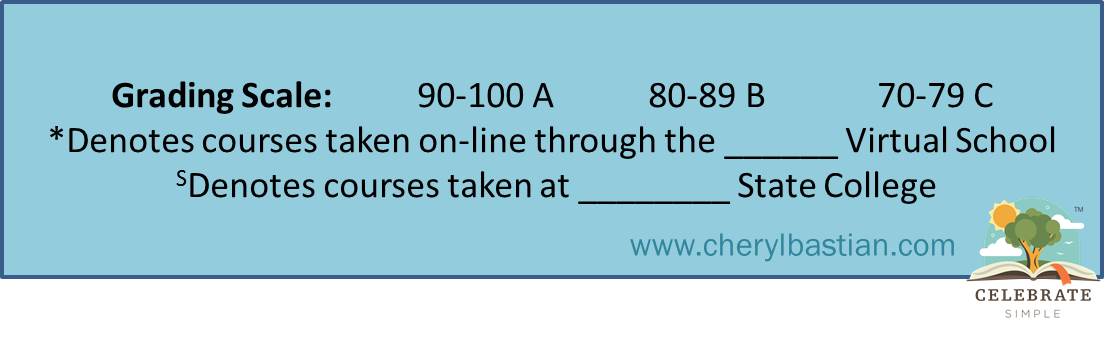
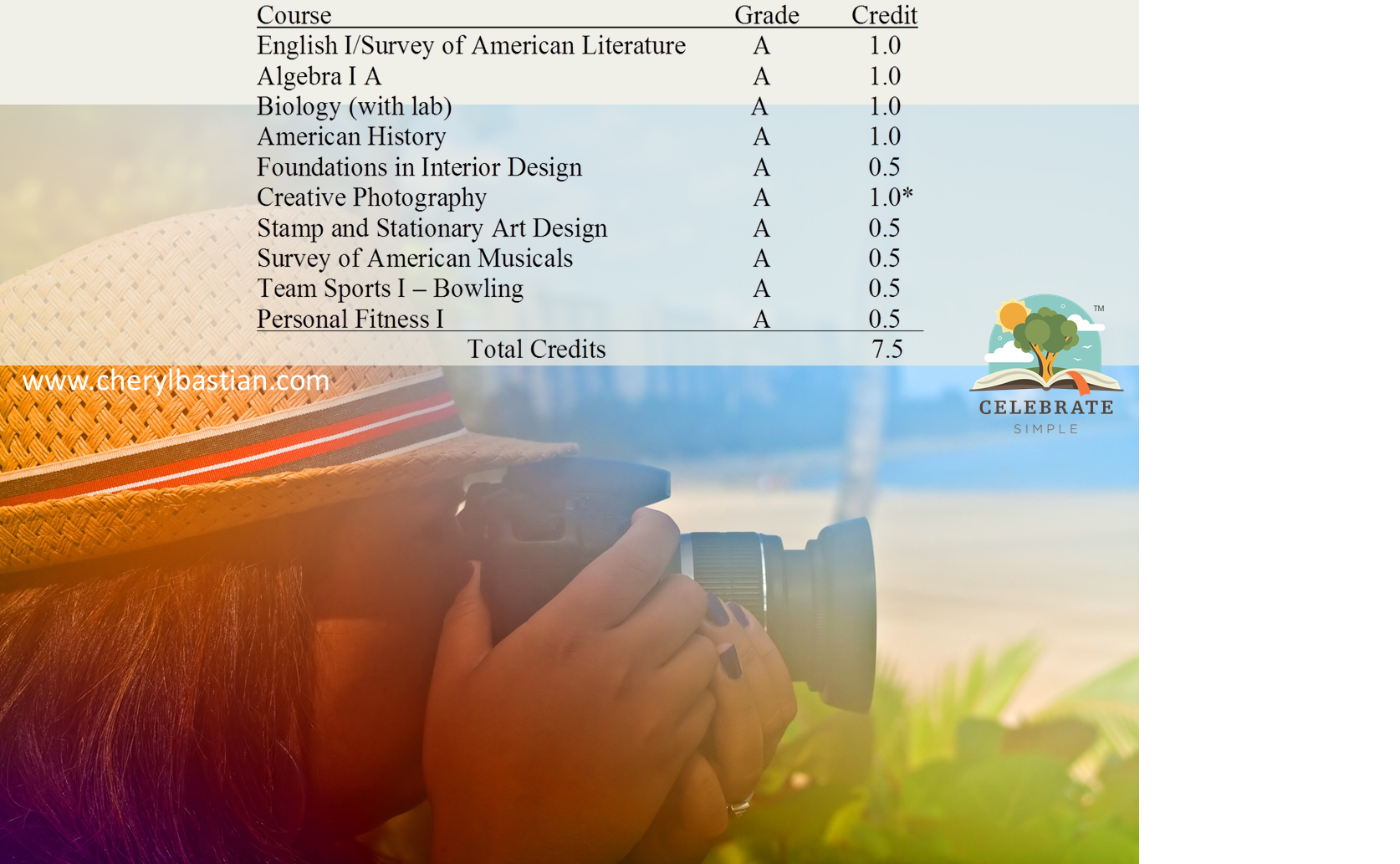
Notation explanation as well as grading scale used for courses taken at home

For example, all of our high school learners completed foreign language online through an accredited source.  I didn't create the course, its content, or grade the work. This was all provided by the online instructor. As the parent overseeing the education of my student (outlined in our state statute), I knew the course was taken and that the source was accredited by the state, and was a transcript-generating entity. I added the course to my parent-generated transcript to provide universities with the information that the foreign language requirement was met. My superscript alerted the schools that they would be receiving an additional transcript for admission purposes. 

Courses taken in the home as well as outside entities.

For some students, there may be several superscripts. I worked on a transcript recently for a student who had taken courses at the local public high school, a private school, an online public school, and a state college. The superscript above the corresponding grades provided admission personnel with a quick, concise visual of where the student had received her high school requirements. 


The parent-generated transcript not only validates the courses, grades, and credits received directly under the parent's supervision, but also offers employers and universities an overview of course variety and environments from which the student benefited, in and out of the home.


This blog post is intended to offer an example of personal experience. It is in no way intended to be legal advice and should not be taken as such. Parents own the sole responsibility for the training and education of their children. 


Celebrating the Senior Year

Senior year.

We’ve celebrated six!

All were bittersweet, yet exhilarating! Emotions and feelings varied day-to-day, even minute-to-minute, for us, as well as our grads-to-be.

These spaces had the potential to bring us together—deepening relationships—through kindness, grace, and room to process the feelings and emotions of the milestone. All were vital to the smooth transitions each would experience on his or her journey.

Each senior year has one’s been different, unique. We’ve had athletes experiencing that “last” game; one athlete continuing to play collegiately. Some seniors pondered out-of-state postsecondary learning versus managing costs and remaining in state. Some have worked in the field while attending school, others launched and then looked for work.

In addition, I've also walked alongside many, many parents of seniors.

Takeaways? Indeed, there are.

There’ve been tears with goodbyes, smiles celebrating weekend visits, and multitudes of reflections accompanied by sweet memories.

The one common thread?

Each parent and each student processes the season in his or her distinct way.

Listen Intently. Listening without an agenda can be difficult, especially if the senior year is ushering in changes, new experiences—moving onto campus, remaining at home and taking on a job, watching as friends enter the next season of life. Being available and listening without chiming in with opinions or throwing a zinger help celebrate the senior year as well as the graduate, with all the uniqueness encompassed.

Give Time. Give them time to process. Changes abound. For some graduates-to-be, the looming change will be moving to a residence hall on college campus. For others, the bittersweet will come as an athletic era comes to a close; not playing the sport enjoyed for a decade or more can be difficult. Learners and parents need space and time to process the pending changes, with grace to reflect on the hard as well as the triumph. Taking time to express affirmation and or offer a hug go along way, too.

Keep an Open Mind. Interests wane. Possibilities arise. A learner who never desired to go to college may decide to apply, last minute, during the second semester of senior year. Likewise, a young adult once considering one college may choose to pursue an employment opportunity. Plans change. And, sometimes plans change more than once! When they do, young adults supported by a loving, supportive community will be more able to consider solutions and possibilities and more likely to navigate change with courage and confidence.


As challenges surface in the high school years, breathe! Consider options. Make adjustments. Encourage your young adult through the journey—the trials and the triumphs. In doing so, you and your high schooler—together—can adjust plans and head out in a different direction, if needed.


Anticipate Beyond the Tassel. As your learner walks through the high school years toward the turning of the tassel, remember that the final walk across the stage is just the beginning. The picture is much bigger than the knowledge stored up in the learner’s mind. It is not even about the universities to which the learner has been accepted. Though there are great accomplishments behind those acceptance letters, they don’t have to define the person. The celebration is about whether the young adult understands his or her strengths and has a willing, open heart eager to make a difference in the community, the nation, and the world.

Congratulations as you turn that tassel!


Transcript Matters: More than One Transcript?

A common question…

“My high schooler received some credits at the local public school, some through an online venue, and still others through dual enrollment. Do I need to create more than one transcript?" 

Great question. Home educated students benefit from a variety of possible learning environments. Some of these entities are transcript-generating, meaning the entity is accredited and provides educational oversight for students who take classes through their venue. Others do not produce transcripts (some co-ops and support group opportunities, private instruction and tutoring, church courses and seminars). 

First, it may be helpful to understand what a transcript is. 

A transcript is a permanent academic record which includes all grades conferred to the named student. It represents the student's academic record; a visual summary of the student's high school years. 

As the homeschooling parent overseeing your young adult's learning, you know your learner's academic record in its entirety, both in the home and away from the home. You know when courses were taken as well as which entity provided oversight for each class, whether it was an accredited transcript producing entity or not. You know whether some credits were earned at the local public school, and whether the course included CLEP or AP content, if the corresponding tests were taken, as well as what scores the student achieved. 

Yes, entities may have conferred grades and credits, but you know where and when those grades and credits were earned. The parent-generated transcript you provide not only validates the courses, grades, and credits received directly under your supervision, but also offers employers and universities an overview of course variety and environments from which the student benefited, in and out of the home. Therefore, every course, grade, and credit is documented in one place--on the parent-generated transcript. It is the master transcript and the parent-generated transcript alerts any employer or university that transcripts will be provided by other entities.


With six home education grads who entered colleges and universities, we experienced this first hand transcript requirements. In every case, having all courses--no matter where they were taken--documented on the parent-generated transcript was required in the admission process. 


How do we note courses taken outside the home?

First, a distinction must be made. We asked

"Was this course taken under the oversight of a legally-recognized, transcript-generating entity?" 

If the course was taken at such an entity, we flagged the course on the transcript, meaning we added some type of notation super-scripted above the grade. An explanations of the flags was added under the grading scale of our transcript. 

Notation explanation as well as grading scale used for courses taken at home

For example, all of our high school learners completed foreign language online through an accredited source.  I didn't create the course, its content, or grade the work. This was all provided by the online instructor. As the parent overseeing the education of my student (outlined in our state statute), I knew the course was taken and that the source was accredited by the state, and was a transcript-generating entity. I added the course to my parent-generated transcript to provide universities with the information that the foreign language requirement was met. My superscript alerted the schools that they would be receiving an additional transcript for admission purposes. 

Courses taken in the home as well as outside entities.

For some students, there may be several superscripts. I worked on a transcript recently for a student who had taken courses at the local public high school, a private school, an online public school, and a state college. The superscript above the corresponding grades provided admission personnel with a quick, concise visual of where the student had received her high school requirements. 


The parent-generated transcript not only validates the courses, grades, and credits received directly under the parent's supervision, but also offers employers and universities an overview of course variety and environments from which the student benefited, in and out of the home.


This blog post is intended to offer an example of personal experience. It is in no way intended to be legal advice and should not be taken as such. Parents own the sole responsibility for the training and education of their children. 


Celebrating the Senior Year

Senior year.

We’ve celebrated six!

All were bittersweet, yet exhilarating! Emotions and feelings varied day-to-day, even minute-to-minute, for us, as well as our grads-to-be.

These spaces had the potential to bring us together—deepening relationships—through kindness, grace, and room to process the feelings and emotions of the milestone. All were vital to the smooth transitions each would experience on his or her journey.

Each senior year has one’s been different, unique. We’ve had athletes experiencing that “last” game; one athlete continuing to play collegiately. Some seniors pondered out-of-state postsecondary learning versus managing costs and remaining in state. Some have worked in the field while attending school, others launched and then looked for work.

In addition, I've also walked alongside many, many parents of seniors.

Takeaways? Indeed, there are.

There’ve been tears with goodbyes, smiles celebrating weekend visits, and multitudes of reflections accompanied by sweet memories.

The one common thread?

Each parent and each student processes the season in his or her distinct way.

Listen Intently. Listening without an agenda can be difficult, especially if the senior year is ushering in changes, new experiences—moving onto campus, remaining at home and taking on a job, watching as friends enter the next season of life. Being available and listening without chiming in with opinions or throwing a zinger help celebrate the senior year as well as the graduate, with all the uniqueness encompassed.

Give Time. Give them time to process. Changes abound. For some graduates-to-be, the looming change will be moving to a residence hall on college campus. For others, the bittersweet will come as an athletic era comes to a close; not playing the sport enjoyed for a decade or more can be difficult. Learners and parents need space and time to process the pending changes, with grace to reflect on the hard as well as the triumph. Taking time to express affirmation and or offer a hug go along way, too.

Keep an Open Mind. Interests wane. Possibilities arise. A learner who never desired to go to college may decide to apply, last minute, during the second semester of senior year. Likewise, a young adult once considering one college may choose to pursue an employment opportunity. Plans change. And, sometimes plans change more than once! When they do, young adults supported by a loving, supportive community will be more able to consider solutions and possibilities and more likely to navigate change with courage and confidence.


As challenges surface in the high school years, breathe! Consider options. Make adjustments. Encourage your young adult through the journey—the trials and the triumphs. In doing so, you and your high schooler—together—can adjust plans and head out in a different direction, if needed.


Anticipate Beyond the Tassel. As your learner walks through the high school years toward the turning of the tassel, remember that the final walk across the stage is just the beginning. The picture is much bigger than the knowledge stored up in the learner’s mind. It is not even about the universities to which the learner has been accepted. Though there are great accomplishments behind those acceptance letters, they don’t have to define the person. The celebration is about whether the young adult understands his or her strengths and has a willing, open heart eager to make a difference in the community, the nation, and the world.

Congratulations as you turn that tassel!


The Power of Experience: Life Beyond the Credits

More Than Credits- Pinterest .png

“What exactly do you mean by More than Credits”?

The title of my high school book has raised thoughtful questions.

l like questions. Questions keep us—parents and learners—pondering, learning, and engaging in dialogue. Questions also keep us processing through our worldview and our thoughts; what matters and prayerfully seeking how to best foster the giftings and interests of our children and teens (even when that looks different than what we envisioned). We should be teaching and modeling for our children the same: pondering, learning, and engaging.

Questions are good. I am glad people are asking.

How did you come up with the title of your book?

The title blossomed from conversations; the dialogues Mike and I have with parents at conferences, workshops, evals, and consults. Our educational backgrounds, research, and personal and professional experiences also weighed heavily in the decision. Mike’s been teaching middle school history for 33 years. My background (aside from homeschooling 27 years) is early childhood education. Together, we’ve graduated four learners from home—two earned graduate level degrees and two are finishing undergrad course work. In addition, we’ve mentored and coached hundreds of families over the past 26 years. We study education, family, and parenting; research and read. Hence, there’s a deep foundation of experience behind why I titled the book More than Credits: Skills High Schoolers Need for Life.

We’re quite familiar with the lack of equipping today’s young adults face. Many are full of knowledge, yet lack practical life skills, problem solving strategies, time management, and experience.

In the all-too-familiar pursuit of rigorous courses, grades, and college admissions, young adults often lack the motivation, time, and skills needed to understand who they are, what strengths and gifts they were created with or could develop, and how their uniqueness could influence their future as well as the future of others.
— Cheryl Bastian, More than Credits

Courses matter. More than Credits doesn’t mean core courses don’t have value. Quite the opposite. Courses are integral to college admission, trade school, entrepreneurship, and most of all, life. However, some of the very courses learners need for life are not being taught or are taking a backseat to courses which will not propel the learner forward in the career or field of choice—for example, an taking an extra core course in science (above what is required for college admission) instead of Personal Finance if the end goal is entrepreneurship or a career in finance. In other scenarios, the courses high schoolers are taking are not the best or recommended courses for a field. An example, a rising senior interested in the field of zoology may benefit more from a marine science course with a biologist involved in research study than an extra foreign language credit. High school is not a one-size-fits-all journey.

Credits matter. More than Credits isn’t setting credits aside or stating they don’t matter. Again, this couldn’t be further from the truth. Credits do matter; but there’s more to learners than the credits earned. Credits feed performance-based worth mentalities, the opposite message that people are created with valuable gifts for a purpose, to be contributors and influencers, leaders and world changers. Our young adults need the skills necessary to walk in those roles.

Experiences matter. Professionals, educators, and parents tell me “graduates are missing experience”. Remember when we were teaching our children as preschoolers and elementary learners? Everyone talked about the importance of experiences—activities and opportunities to learn by doing, learn from people versed in a field. Those days were all about hands-on, discovery, problem solving—real life. The need for experience and application doesn’t change—ever. Experience is a proven teacher with retention rates of approximately 70% (and higher) when people are involved in doing something. Yet, when the middle and high school years roll around, we lean toward the opposite—sit in front of a screen or at a desk, passing tests with minimal to no retention or application. It wasn’t always this way. What are we doing about that known gap? How will teens and young adults get needed experience? More than Credits puts individualized experience and application back into learning. Furthermore, it encourages high schoolers to get out into their fields of interest, through volunteering, job shadowing, professional mentoring, and interviewing. Amid these opportunities, learners are able to gain experience and make valuable professional connections. Often the connections lead to employment, hence the experience future employers require. The activities in More than Credits are about engaging learners in using or discovering strengths and interests while gaining the experience needed for future employment or making a difference in the lives of others.

High school is more than checking boxes and meeting requirements. It’s about experience, gaining knowledge and skills, learning from professionals in a field, applying what’s learned to real-life scenarios. It’s about teens and young adults knowing how to learn, where to find answers, and how to solve problems—being equipped with the needed skill sets and emotional intelligence desired by employers and necessary for success in a career field.

There’s power in experience, an empowerment which can be built on and remain for a lifetime. That’s more than credits!


How to Create Titles for Elective Courses

Copy of Purple Party Collage Birthday Pinterest Graphic (1).png

"What are some common titles for elective credit in high school?"

Before titling a course, one must understand the difference between core and elective courses and how these terms are used in the educational world—the "education-eze". Colleges use “education-eze”.

Parents must also understand what is and isn't required by their state school law statutes. Though some colleges and universities hire home education admission personnel versed with knowledge to help homeschooled applicants, other advisors are not always familiar with state statutes, requirements, or procedures. Knowledgeable parents have the means to empower student applicants who may face questions.

Core courses are offerings in the major discipline areas of English, math, social sciences, and natural sciences. Some districts (and colleges) include foreign or world languages in core courses. All other courses are considered electives.

For this post, I am revising an elective list I created in 2015. The list does not include courses most often considered core academics--for example, Calculus or British Literature--though those core courses could also be used as electives if the core course requirements have been meet.

English Electives (when not considered part of the core content English I, English II, English III, and English IV)

Shakespearean Theater

Greco-Roman Theater

Short Stories

Poetry (perhaps of a specific historical era or demographic)

Writing for Print and Publication

Creative Writing

Yearbook

Digital Publishing

Ancient Languages

Biblical Studies: Old Testament

Biblical Studies: New Testament

Communication Electives

Speech (this course may considered a core by some schools)

Competitive Speech

Impromptu Speech

Expository Speech

Policy Debate

Lincoln-Douglas Debate

Media Productions

Mathematics Electives

Business Mathematics (some schools no longer consider this a high school level course)

Personal Finance (this course is often considered a required course for some schools but an elective for others)

Social Science Electives

Comparative Government

Global Studies

International Relations

Introduction to Law

Mock Trial

Constitutional Law

Independent Study: Foreign Policy

Introduction to Criminal Justice

Psychology (this course may be considered a core course for some schools and an elective for others)

Sociology

Anthropology

Archaeology

Family and Consumer Science 

Contemporary World Issues

Ancient Civilizations

Independent Study: The Korean War

Medieval History

Introduction to Social Work

Child and Adolescent Psychology

Philosophy

World Religions

Theology

Church History

Internship: Youth Ministry

Natural Science Electives

Environmental Science

Animal and Agricultural Sciences

Introduction to Agriscience

Equine Science

Equine Medicine

Introduction to Veterinary Science

Introduction to Forestry

Botany

Entomology

Zoology

Astronomy

Introduction Aerospace Science

Forensics

Introduction to Health Sciences

Performing/Fine Arts Electives

Introduction to Drama

Musical Theater

Art History (perhaps add a historical era, for example Asian Art History)

Art Appreciation

Choreography

Dance Technique (consecutive years add beginning, intermediate and advanced)

Competitive Dance

Introduction to Ball Room Dance

Stagecraft

Set Design

Theater Production

Two-Dimensional Art

Three-Dimensional Art

Sculpture

Ceramics

Drawing and Painting

Cartooning and Caricature

Printmaking

Pottery

Creative Photography

Digital Photography

Band

Orchestra

Symphonic Band

Wind Ensemble

Jazz Ensemble

Keyboard

Piano

Music Theory (consecutive years add beginning, intermediate and advanced)

Music History (perhaps add a historical era or genre, for example, History of Jazz)

Music Appreciation

Physical Education Electives

Personal Fitness (this course is sometimes considered a required course for some schools but an elective for others)

Nutrition and Wellness

Aerobics

Tennis

Golf

Volleyball

Competitive Swimming

Water Polo

Lifesaving

Advanced Lifesaving

Team Sports

Recreational Sports

Beginning Weights (consecutive years add intermediate and advanced)

Weight Training (often accompanies sports training and play) 

Sports Psychology

Introduction to Sports Medicine

Care and Prevention of Athletic Injuries

Sports Rehabilitation

Business Education Electives

Accounting

Marketing 

Copyright Law

Advertising and Sales

Principles of Entrepreneurship

Banking and Finance

Business Principles

Foundational Principles of Small Business

Business Technology

International Business

Global Business Studies

Computer Science Electives

Computer Fundamentals and Programming

Introduction to Computer Systems

Computer Design and Repair

Keyboarding

Word Processing

Graphic Design

Digital Design

Web Design

Digital Arts

Computer Gaming 

Home Economics Electives

Fashion Design

Textiles and Fabrics

Clothing Construction and Textiles

Machine Sewing

Quilting and Applique

Interior Design

Introduction to Early Childhood Education

Nutrition

Principles in Food Preparation

Principles in Food Preparation: Pastry

Principles in Food Preparation: Desserts

Principles in Food Preparation: Main Courses

Principles in Food Preparation: Appetizers

Introduction to Culinary Arts

Introduction to Pastry

Cake Decorating

Home and Automotive Repair

First Aid and CPR

Emergency Preparedness

Vocational Electives

Cosmetology

Cabinet Making

Carpentry

Trim and Finish Carpentry

Masonry

Landscaping

Horticulture

Floral Design

Landscape Architecture

Building Design and Architecture

Drafting

Technical Drawing

Plumbing

Welding

Auto Mechanics

Diesel Mechanics

Small Engine Repair

Electronics and Circuitry 

When our young adults are reading, working on research, studying content, or participating in an experiential opportunity, I search for potential titles. If I can't find a title or course content close to what our learners are studying, I search for high school courses (and in some cases college courses) offered at other high schools across the nation. Those resources usually allow me to find a title--or at least give me a springboard--which accurately describes the content being learned. 

If you want to learn more about documentation of elective credits and how to create college admission paperwork, check out this post.

This blog post is intended to offer an example of personal experience. It is in no way intended to be legal advice and should not be taken as such. Parents own the sole responsibility for the training and education of their children. 


Using Living Books in High School

Chores (5).png

When we started our homeschooling high school journey in 2003, I was determined not to leave the learning power of Living Books behind in the elementary and middle school years. 

YOU can use Living Books in high school.

Our high school learners were greatly impacted by the Living Books they chose. In fact, several titles greatly influenced their career choices and life goals.

When we began our high school journey, the first content area in which we incorporated Living Books was history. This seemed a natural choice since we had been using Living Books--biographies, autobiographies, and historical fiction--to accent our history studies in the elementary and middle school years. 

History

Aristotle. Complete Works of Aristotle, Vol. 1. Princeton University Press, 1984.

De Tocqueville, Alexis. Democracy in America and Two Essays on America. Penguin Classics, 2003.

Franklin, Benjamin. The Autobiography of Benjamin Franklin. 1790.

McCullough, David. John Adams. Simon &Schuster, 2002.

McCullough, David. The Wright Brothers. Simon &Schuster, 2015.

Metaxas, Eric. Amazing Grace: William Wilberforce and the Heroic Campaign to End Slavery. Harper One, 2007.

Rousseau, Jean-Jacques. On the Social Contract. Dover Publications, 2003.


The next content area in which we chose to incorporate Living Books was science. It was also a natural fit, especially for learners who had interest in specialty areas or who wanted to dig deeper to learn more about scientists and inventors. As our young adults advanced through the high school years, we included adult and college level materials. 

Science

Burton, Mary June. Louis Pasteur: Founder of Microbiology. Franklin Watts, 1963.

Carson, Ben, and Cecil Murphey. Gifted Hands: The Ben Carson Story. Zondervan, 1996.

Douty, Esther. America’s First Woman Chemist: Ellen Richards. Julian Messner, 1961.

Einstein, Albert. The Meaning of Relativity: Four Lectures Delivered at Princeton University, May 1921 (Classic Reprint). Forgotten Books, 2017.

Keller, Helen. The Story of My Life. 1903. Signet, 2010.

Williams, Beryl, and Samuel Epstein. Medicine from Microbes: The Story of Antibiotics. Julian Messner, 1965.


Reaching our creatives with written materials was challenging at times, unless the reading was related their artistic gifting or interest. Perhaps you find yourself in that quandary. The effort you put forth to help your high schoolers find books, matters. Make suggestions. Go to the bookstore together. Visit the library and browse the shelf. Find out who influences or has influenced the field. The effort speaks to your interest in what matters to your teen.

I did discover I had to let go of my rigid definition of what a Living Book was in order to be open to the plethora of possibilities I would  have otherwise discounted.

The Arts

Astaire, Fred. Steps in Time: An Autobiography. Cooper Square Press, 2000.

Kistler, Mark. You Can Draw in 30 Days: The Fun, Easy Way to Learn to Draw in One Month or Less. Da Capo Lifelong Books, 2011.

Tada, Joni Eareckson, Joni. Bantum Books. 1978.

Trapp, Maria. The Story of the Trapp Family Singers: The Story Which Inspired The Sound of Music. William Morrow Paperbacks, 2001.


What about an athlete who loves to read? How can Living Books be interwoven in a personal fitness or weight training course? And, what about an athlete who would rather play ball than read?

Sports

Dorman, H. A., and Karl Kuehl. The Mental Game of Baseball. Diamond Communications, 2002.

Hershiser, Orel, and Jerry B. Jenkins. Out of the Blue. Wolgemuth & Hyatt Publishers, 1989.

Kilmeade, Brian. The Games Do Count: America’s Best and Brightest on the Power of Sports. HarperCollins, 2004.


Living Books have the power to pull in even the most reluctant reader!


Living Books can give life to any subject, if we allow them the opportunity to do so. Recently, one daughter began to lean toward personal growth and leadership materials. I worked on ways to incorporate what she was reading into an elective: Personal Development and Career Exploration. I could have also titled the course Interpersonal Communication, based on the resources she chose. When I wrote More Than Credits, I included the books and activities into an elective framework. It is one of five electives featured in the book.

Distance Learning and Homeschooling

distance.png

“Is the quarantine, distance learning like homeschooling? I mean, the kids are home, learning, so how is it different?”

This question. I’ve been asked it in many forms over the past weeks, but the underlying inquiry is the same.

Short answer. Not the same...SOMETIMES.

Sometimes?

We’re a homeschooling family of 26 years with four graduates. My husband is a 32-year veteran public school teacher currently instructing students via distance learning platforms. We’ve also been home education evaluators for 25 years.

We’ve sat around tables over the years; talking and looking through work samples produced by learners of all ages, walking with families from Kindergarten through graduation. We’ve seen the results of engaging a learning style and observed learners utilizing a great spectrum of learning philosophies. There’s been creative use of life opportunities and a collage of amazing educational creativity.

There are many types of home-based learning. It's a vast spectrum of possibilities. We’ve seen the results as we worked with families. Each family decides what works best for their family and begins to implement. There’s tweaking and adjusting to find good fits for learner. It’s not formulaic or set in stone. Some choose online learning exclusively, similiar to what my husband is doing with his public school students. The learners sit at the computer—read material, watch videos, take quizzes and tests—completing what the instructor assigns for all or most of their courses. That's one end of the spectrum. On the other end of the continuum, there's home education where a family uses everything they have at their fingertips and every part of life to promote thinking and learning—primary sources, museums, online courses, field trips, audio materials, cultural opportunities, civic events, library materials, entrepreneurial adventures, experiential activities, internships, mentorships, volunteer work, and even apprenticeships—to foster interests and cultivate the unique gifting of the learner. Families land all along this spectrum and some use different venues and resources for each child in the family. Learning doesn’t need to look the same for every child and although some home-based learning is like the distance learning many children and teens are experiencing in this season—where a teacher hands out all the work to be done and learners complete work virtually— there's also a plethora of other valuable options.

Home education is not bringing school home; duplicating what happens in a classroom. Yes, there are lessons, but they don’t all happen on paper or even on the computer. It is a tutorial method of education, an adjustment in teaching mode or method to the needs and developmental time table of the child. Sometimes that adjustment means not doing all the problems in a lesson because the material has been mastered. The time spent doing needless problems can be put toward learning another skill or free time to dig into an interest. At other times, home education allows for adjustments in schedule. An example would be taking a brain break after 10 minutes to refill a water bottle or do a few jumping jacks, maybe even ride a bicycle before heading back to a lesson. This is difficult to do in a group setting where jumping jacks might be considered a distraction to another student. With a limited number of learners it is easier to individualize schedules to optimize instruction. Home education also offers the opportunity to take learning off the page as much as necessary. This may take the form of observing life cycles, like caterpillars changing to butterflies or collecting tadpoles, instead of reading about the processes in a book. Experiential learning at the middle and high school level is possible, even preferable in many cases. In our years of coaching parents and young adults, we’ve encountered business start-ups and growth, video production projects, event planning, propagation of banana plants and engagement in sustainable gardening, award winning musicians, hopeful future Olympians, even the completion of the AA in conjunction with high school graduation. The possibilities are as vast as the learners who engage in this type of home education.

Side note #1. I am giving a shout out to the many educators I know who intentionally make experiential learning a priority because they know its value. I admire these educators—who often have to overcome obstacles to bring their students what they need because they know it’s best. Students are fortunate to have such opportunities. If that’s YOU, YOU matter and deserve KUDOS for the ingeniousness ways you make learning come alive in the classroom.

Side note #2. What many families are doing currently is crisis schooling—schooling with social distancing while sheltering at home under uncertain circumstances. Those who found themselves orchestrating distance learning did so with short notice while also navigating other life situations including job transitions. Most of us who chose to home educate didn’t have these obstacles to navigate. If you find yourself in the midst of circumstances you didn’t choose, my hat’s off to you. YOU can do this.

For those wondering if home education has changed, it’s a bit different, even for those of us who’ve been doing this awhile. Families are limited in comparison to what they normally have access. However, there is also possibility! The time is ripe for thinking, problem solving, and trying something different; with learning, that’s what people do—look for possibilities. Problem solve. Ask questions. Adjust. Ask more questions. Adjust and try again.

How is this season different, even for home education families?

With change, there’s opportunity to learn differently (hopefully a short season).

  • Libraries are closed. Families must rely on their home libraries or online audio resources. We’ve personally enjoyed more Kindle and Audible. But, it’s still not quite the same—we love our home library but long for the ability to, once again, reserve resources online and have them dropped at our doorstep.

  • Museums are closed. This rich cultural option is a missing component of art education, however we’ve discovered great online options—San Juan Museum of Art, The Vatican, and these—for now.

  • Theaters are closed. Don’t let this temporary inconvenience stop the love of theater. Our family has enjoyed the free showings at the Globe Theater. You can, too.

  • Contact with people, in-person outside our family, not an option. We love learning from other people. In fact, we discovered we can gain nuggets of information from almost every interaction—produce manager, postmaster, auto mechanic, neighbor, waiter. Though we can learn from online tutorials and videos, there’s no substitution for real people, real interactions. These interactions are missed, for sure.

What are the possibilities?

  • There is time for digging deep into subjects of interest (assuming there is time built into the day to do so). When we plan time and offer resources to investigate (microscopes, magnifying glasses, water, sand, art supplies, fabric, and on and on), learners begin to understand they can wonder and discover and not have to wait for someone to tell them what to do and how to use resources. They learn to solve problems and find solutions. There’s even often an awareness that they can manage their time; time management is a life skill and comes with practice. These discoveries are freeing and nurture curiosity and a love of learning.

  • There is time for family interaction. People crave relationship. We want to be in conversation, to know someone is available to listen and help process. One-on-one time, talking about what’s being discovered and learned. And, there are memory making moments: enjoying a game, eating a meal together, navigating conflict resolution, solving a puzzle, the possibilities for memorable time together are endless. Relationships matter, but they take time. With home education, we’ve got time.

Is distance learning like homeschooling?

Sometimes it is, other times it isn’t.


What If My High School Learner Is Interested in Animal-Related Sciences?

animal.png

As we work with families, animals continue to be a common area of interest. Honestly, little learners tend to carry the same interest. Animals are fascinating. They’re part of our world, in our lives, and they’re real and make learners curious…sometimes continuing well into the high school years.

What to do?

Parents usually ask, “Can we put together a course with the niche interests of our learner in mind?”

First, check what your state homeschool laws require.

Second, if your animal-loving leaner is also an athlete with sights set on college athletics, double-check the NCAA eligibility guidelines.

Third, if there’s a hint of what post-secondary plans may look like down the road, consider those (and realize they change).

With that knowledge in mind, move forward.

Pull Resources

If you’re a proponent of unit study learning, think unit study. That’s really what designing (or allowing the young adult to create while completing an independent study) a high school course is all about—gathering ideas and resources. If you haven’t used unit studies or heard of them, don’t worry! You (and your learner) will get hang of it. It’s really about following in interest.

Determine the possibilities for content. Often, when one of my learners has a working knowledge of a topic, we build on that foundation to get the brainstorming ball rolling. From that starting point, we can list other topics toward which the learner wants to devote time. Sometimes ideas will come from past studies, related textbooks, or nonfiction resources. In the case of animal-related sciences, those topics might include

  • Veterinary terminology

  • Anatomy & physiology (body systems of specific animals)

  • Animal nutrition

  • Animal behavior

  • Service animal training and care

  • Proper exercise of companion animals

  • Animal grooming

  • Care and cleaning of animal facilities

  • First aid for animals

  • Disease control

  • Animal reproduction (including genetics and gestation)

  • Clinical examination procedures and related lab equipment

  • Lab techniques

  • Veterinary mathematics (dosage and concentration, calculations and conversions)

  • Animal welfare and legislation

  • Careers in animal-related sciences

We make note of those and begin to keep our eyes and ears open for related educational opportunities.

We’ve experienced the fruit and rewards of this kind of learning. Often, when we get to the end of a season and I step back and reflect, the results are more amazing than I could have planned or imagined. And, (BONUS) the learner is motivated and engaged, and content is retained. WINS all the way around!

Capitalize on Experiential Learning

We have found experiential learning (job shadowing, volunteering, apprenticing, part-time employment in the area) extremely beneficial. Not only are content areas interwoven, but the experience can foster important relationships which may lead to future employment.

In the area of animal science, think about the options

  • Volunteer at a zoo or aquarium

  • Volunteer at a science center

  • Volunteer at an AKC event

  • Participate on a research team or in a study

  • Apprentice with a dog agility trainer

  • Visit service dog training facility or train a service animal

  • Work as a pet grooming assistant

  • Serve as a vet helper

  • Volunteer with the local Audubon Society

  • Participate in Citizen Science project

  • Work in a pet store

  • Work with a breeder

  • Serve as a canine foster or rescue caregiver

  • Work or volunteer at a horse barn

  • Visit and observe venues were animal care and training, office procedures, and professional practices can be observed, for example

  • Visit colleges and universities offering majors being considered and tour their animal science buildings

Don’t forget about 4H! There are offerings for animal science topics and resources.

Interview Professionals

We’ve also learned from our experience that field trips are extremely beneficial, especially if there is time to interview or talk with professionals in the field. Talking with professionals has been advantageous for our children and teens as they were able to gather insights into the field or learn about the job market outlook. In addition, our learners gained nuggets of content we wouldn’t have known to incorporate. Learning from professionals in the field is beneficial in many ways.

If you don’t have a wide selection of local animal care or service opportunities, consider learning from and about famous vets or others who work with animals. The internet affords plentiful tutorials and professional interviews.

Use Nonfiction/Primary Source Documents/Professional Resources

Online resources—within parameters—offers the ability to learn from primary source documents and professional resources. These can be used to enhance and independent study or reinforce and build on what is being learned experientially through volunteering, job shadowing, apprenticing, or part-time employment. Curriculum guides, course descriptions, textbook table of contents, and materials recommended by professionals in the field can guide and build a course. As you gather helpful nonfiction, primary source, or professional resources, consider these (and more—as your learner digs into content).

Look for ways your high schooler can learn about possible careers in areas of animal care and service. Give them space to think outside the box to things like wildlife conservation veterinarians, zoo veterinarians, and animal nutritionist.

Keep in mind, several typical high school courses (biology, marine science and human anatomy and physiology) are beneficial to animal care and health sciences. The content of these classes is related and relevant, often foundational. In addition, some universities require these traditional core course options for admission. Should your learner be considering vet medicine, marine biology, or another animal-related career, be knowledgeable about what universities are requiring (but don’t let those requirements overshadow the richness and depth experiential learning—hands-on—offers learners). Both book knowledge and experience are important.

College and university admission requirements will vary as will the courses each institution requires for degrees. Be informed about these differences as well as be familiar with the professors who teach at schools of interest. What is taught in courses varies professor to professor. If a student has niche area of interest and an influencer in that field teaches at a particular university, take note.

Oregon State offers these suggestions.

Cornell University College of Agriculture and Life Science

University of California - Davis recommendations for high school students

Read Biographies

When we build a course, we often add biographies of people in the field of interest. For starters in animal care and study fields consider James Herriot, Steve Irwin, James Audubon, and Temple Grandin.

Investigate the History

Every topic has a history, a story of how that industry or field changed over time. Animal-related sciences are not different. Adding this aspect to the course can be a fascinating journey.

Tie in English

Parents often ask how to tie in English to niche areas of interest. I encourage them to think real-life. What writing may be a natural part of the career or field. Consider

  • Note the study skills. Reading, researching, skimming, note taking, retelling what was learned in a day’s time are all important language arts skills. Often these go unnoticed, yet the repetition of using these important study skills allows the student to become a more efficient learner, not to mention time manager.

  • Have the learner write a paper on something or someone of interest. 

  • Learn the stylistic form for the academic discipline. Does the content area format in MLA or APA? Learn that format when writing papers for this course.

  • Keep a running list of vocabulary and terminology related to the subject—new words which are foundational to further learning.

  • Write thank you letters for interview, job shadowing, or volunteer opportunities.

  • Write resume entries for an volunteer experience or employment opportunity.

  • Add animal-related literature: Just So Stories by Rudyard Kipling, All Creatures Great and Small by James Herriot, and Watership Down by Richard Adams.

Record: Tips for Independent Learning

What do I love about this type of learning (from what we've experienced)? Our children become very knowledgeable about the field and often its niche areas and they run with the learning. If they are learning something independently, based on something they wanted to dive into and are managing their study time, I ask them to bullet point the content they learn (animal behavior, medicines for bacterial infections, etc) and copy any URLs in a Word document. I also ask them to record author and title of any books or online resources they use. In doing so, I have what I need for state records or for documents which might be needed for college admission.

This general format can be used with any topic of interest.

This post is not intended as legal advice or educational counsel. The content is based on the author’s experience. It is the parent’s sole discretion to use this information as he or she sees fit as they fulfill their responsibility as parent overseeing the education of his or her child.

How to Use What You Have: Homeschooling High School Nutrition and Wellness

fitness.png

We’ve adopted a phrase.

Use what we have to boost what we know.

In this season of pandemic shelter-at-home orders—with libraries closed and resources narrowed—we are pushed to look for alternatives. Hence, the above phrase could mean several things.

Use the resources, items, and interests we have to learn something new.

Or

Use the resources, items, and interests we have to deepen, reinforce, and apply knowledge we learned previously.

Today, my mind is on high school, specifically nutrition and wellness!

Parks and gyms are closed. For some, stress eating is a challenge. For others, needed food sources are difficult to find. How do we practice healthy habits in the areas of nutrition and wellness with the parameters under which we are living?

This is where life meets learning!

The conversations about boosting the immune system. The trials and errors of building a personal fitness plan without a gym. The recipe substitutions and related research. The online stretching or aerobic classes.

Learning is taking place.

If your high schooler is engaged in this type of learning, it matters and it’s valuable.

In my book More than Credits: Skills High Schoolers Need for Life, I include practical, applicable, real-life activities to give parents and high school learners a jumpstart toward thinking outside-the-box in the areas of nutrition, wellness, and personal fitness. Ideas include

  • Adjust a recipe, considering personal health and dietary needs.

  • Utilize an online aerobic workout tutorial to build cardiovascular health.

  • Learn how to take, record, interpret, and monitor vital signs (pulse, respiration, and blood pressure).

  • Compare standing blood pressure to lying down.

  • Calculate personal Body Mass Index (BMI) for each family member.

  • Compare heat exhaustion to heat stroke, including prevention, symptoms, and treatment.

  • Determine how social, cultural, and emotional influences impact nutrition and health choices.

  • Study the effects of stress on physical and mental well-being.

  • Research how to keep the body hydrated, determine ounces required, and implement a hydration plan.

  • FInd three types of online calorie calculators and compare site features.

  • Explain the difference between whole foods and processed foods.

  • Research the growing seasons in your area.

  • Plant a vegetable or herb garden.

  • Enroll in an online culinary course or tutorial series for a specific area of interest: pastry, main dish, gluten-free, keto.

  • Clean and restock a freezer or refrigerator.

  • Learn how to wash hands properly for food preparation.

  • Learn first aid for common kitchen accidents: burns, scalds, cuts, puncture wounds, allergic reactions, and choking.

  • Learn how to properly and safely use a gas grill.

  • Research and list ways to reduce the severity and exacerbations of autoimmune disease.

This is a sampling of ideas from More than Credits. And, given our current situation and the needs and interests of your learner, you will discover others opportunities which are individually applicable to your family or teen. The outcomes may not be a percentage correct on a test or page filled with fill in the blank questions. Instead, it may be a casual conversation or a task completed together (like cleaning the fridge properly or doing a workout together. The end result will be your teen learning and applying self-care. This is worth more than the credits. It is life-impacting and it matters.

More than Credits includes frameworks, resources, and living book and biographical suggestions for five elective credits: personal fitness, nutrition and wellness, personal development and career exploration, philosophy, and personal finance.

COVER_More Than Credits_Book_byCherylBastian.jpg

How to Use What You Have - Geography

maps.png

We’ve adopted a phrase.

Use what we have to boost what we know.

Could mean one of two things.

Use the resources and items we have to learn something new.

Or

Use the resources and items we have to deepen or reinforce knowledge we learned previously.

Today, my mind is on geography and map skills.

In the era of digitalization and GPS, are geography skills still valuable?

Every family must decide, but our learning experiences have proven to us that this skills are important. Though amazing navigational tools and digital helps make finding our way easy, foundational concepts remain necessary if a person is to have context for conversation and learning. For example, if a child is engaged in a discussion about France, knowing where France is located it essential to understanding the context and content being shared. Likewise, if a child is reading a book set in the Alps, knowing the geographical relevance provides important insight to the characters, setting, and plot.

Geography does matter.

How can we add to our learner’s knowledge, to what they know as well as to what they might want to discover?

If you have a world map, atlas, or globe (ours would require a good dusting!), a child or teen could

  • Learn the states and their capitals and label on a printable map.

    • Older learners can learn to spell the states and capitals.

  • Find and identify the seven continents - North America, South America, Europe, Asia, Africa, Australia, and Antarctica.

  • Locate the major ocean basins - Atlantic, Pacific, Indian, Arctic, and Southern.

  • Print a blank map of one of the continents. Locate and label the capitals and five major cities for each country. Draw in any significant land features—mountains, lakes, rivers, and deserts.

  • Choose a country. Draw the country flag. Find out what major resources are available in the country. Research major landmarks. Discover the culture and customs. Consider creating a diorama, poster, or Powerpoint of what was learned.

  • Research online to find a printable crossword puzzle or word search about a continent of choice. Use your atlas or map to help solve the puzzle.

  • Read geography-related picture and non-fiction books.

  • Take a trip around the world, together. Divide the family into two teams. Each team will need a map and a scavenger hunt (hit the print button). Based on the ages of your children, choose either a specific amount of allotted time to complete the hunt or simply determine the winner to be the first team to find all the items.

Have maps, globes, geography-related resources? Consider how your family might travel the world while learning or reviewing together.

Every. Moment. Matters. when making use of what’s available.

Learning from Interviews

interviews.png

If your learner had the opportunity to interview a professional, would he or she be prepared?

We can’t possibly know everything about every profession. No one can. However, parents do have the ability to coach middle and high schoolers through the process of being prepared to ask questions, should they find themselves in a situation where they can ask questions.

This is an important step in empowering teens to learn from people in professions of interest.

Let’s say your high schooler is interested in veterinary medicine. Your background is in business and finance.

How do you help your young adult learn more about vet medicine?

Find a trusted professional who is willing to share his or her passion, and then ask. Most people are eager to talk about what they love. In the process, your young adult is afforded a chance to learn about the education requirements, niche areas of the profession, and perhaps the career outlook at the time when you learner will be trying to land a job. Should an ongoing mentor relationship form, there may be a potential connections made for future employment.

Identifying a person who could be interviewed is the first step. The second step, preparation, is key. Intentionality often reaps the greatest reward (another one of those life lessons our high schoolers learn from experience.

Preparing for an interview is essential. If someone carves out time from his or her busy schedule to meet with a high schooler, preparation is a form of respect. The meeting not only allows the learner to glean the most helpful information possible, but also shows gratitude for the professional’s time. Some high schoolers will decide they need help brainstorming a list of questions to be asked. Others may determine there is a need to role play a mock interview. And, there will be some who prefer to work more independently, creating a list and seeking input or feedback once their preparation is complete. This process is another step on the path to discovering how one learns best through the unique benefit of experiential opportunities.

When our high schoolers showed interest in an area and wanted to talk to professionals or tradespeople, we developed a list of questions. Here is a list to jump start the thinking process. I offer a full list in the appendices of my book, More than Credits.

  • How did your high school experiences benefit your career?

  • Where did you attend college?

  • How or why did you decide to choose this college?

  • How did your post-secondary studies influence your career?

  • Which post-secondary courses were particularly beneficial in your career preparation?

  • Is there something you feel would have been helpful—maybe even a different major—than what you pursued?

  • How do you see your career field changing in the next five years?

When preparing to interview someone in a trade or technical field, we adjusted our list of questions to address trade-specific aspects of a field. The complete list is also included in the book, but these samples provide a place to start as you and your learner develop a list of questions.

  • Did you earn industry certifications and if so, which were helpful to you?

  • What should I consider as I research post-secondary education options?

  • What skills do you use every day?

  • What types of writing do you do in your field?

The high school journey is more than taking tests and finishing study guides.

There is a place for these in education, but it is important to remember these aspects of learning should not overshadow and crowd out some of the most beneficial ways our young adults gain knowledge—through experiential learning opportunities like interviewing professionals.

More than Credits is available on this site or through Amazon.

encourage others.png

College and University Admission Requirements for Home Education Grads

gradadmission.png

I speak to rooms full of parents--living rooms conversations to packed convention halls--considering and navigating a home education journey for their middle and high school young adults. Most often we talk about specifics and how-tos. At some point in the presentation, usually during a Q&A session, I am asked to address specific admission requirements.

There isn’t a one-size-fits-all answer to the question.

The answer to the question varies per institution and the status of the student applying—home education, private school, or transfer student.

Home educated in our state means enrolled in the Home Education Program with the county of residence. Those students are defined as home education students (homeschooling) and will apply to colleges as home educated, non-traditional, or non-accredited graduates. The terms used for the admission status varies college to college.

In our state if the student chooses to enroll in a private school for classes once, twice, or three or more times a week--or as a place of record--that student is considered a private school student and will apply to colleges as a private school graduate. Some colleges and universities require private schools to be accredited, by the state or by a regional accrediting agency. This is important to note as not all accreditation is considered equal by some universities.

Generally colleges welcome home educated students with unique educational and extra-curricular experiences and varied community service opportunities, but it is always wise to check on the admission requirements of particular schools of interest.

Don't assume.

  • Some universities are hiring admissions counselors designated to serve home educated students. After reading online admission requirements, make contact with the counselor. Advanced research and knowledge demonstrates interest and initiative, especially if the contact and inquiries are made by the student.

  • A running list of questions may be helpful. Help your learner process what he or she may want to ask.

  • Early research allows parents and students to plan well. Gain the knowledge you need (but don’t panic if your learner doesn’t quite know what he or she wants to study or where he or she wants to attend—there’s time)!

Locating specific requirements for home educated applicants takes time. This is why I include and update links to admission requirement pages as I find them. If your student's college of interest is not listed below, try 

  • typing "homeschool" or "home education" in the search box of the college website.

  • searching "homeschool coordinator" in the search box of the college website.

  • contacting the homeschool admissions coordinator. Colleges and universities are hiring personnel to help their home-educated applicants.

  • looking for homeschool admission requirements under the heading "non-traditional". Home education is considered a non-traditional method of education by many universities.

Direct links to information relevant to home-educated applicants are included as available. These links are a guide. Be sure to continue research based on the unique needs of your high school learner.

Agnes Scott College, Decatur, GA

Amherst College, Amherst, MA

Anderson University, Anderson, SC

Appalachian State, Boone, NC

Arizona State University, Phoenix Area, AZ

Ave Maria University, Ave Maria, FL

Barnard College - Columbia University, New York, NY

Berry College, Mount Berry, GA

Bellhaven University, Jackson, MS

Belmont Abbey College, Belmont, NC

Bentley University, Waltham, MA

Bowdoin College, Brunswick, ME

Bradley University, Peoria, IL

Brandeis University, Waltham, MA

Brown University, Providence, RI

Bryan College, Dayton, TN

Bucknell University, Lewisburg, PA

California Institute of Technology, Pasadena, CA

Calvin University, Grand Rapids, MI

Cedarville University, Cedarville, OH

Central Methodist, Fayette, MO

Charleston Southern University, Charleston, SC

Cleveland Institute of Art, Cleveland, OH

Colorado Christian University, Lakewood, CA

Colorado State University, Fort Collins, CO

Columbia University, New  York

Cornell University, Ithaca, NY

Covenant College, Lookout Mountain, GA

Davidson College, Davidson, NC

Drexel University, Philadelphia, PA

Emmanuel College, Franklin Springs, GA

Emory, Atlanta, GA

Emory-Riddle Aeronautical University, Daytona Beach, FL

Flager College, St. Augustine, FL

Florida Agricultural and Mechanical University, Tallahassee, FL (click on Academic Core Units and Homeschool/Non-traditional)

Florida Atlantic University, Boca Raton, FL

Florida Gulf Coast University, Ft. Myers, FL (click Units tab for specific courses)

Florida Institute of Technology, Melbourne, FL

Florida International University, Miami, FL

Florida Polytechnic University, Lakeland, FL

Florida State University, Tallahassee, FL

Franciscan University, Steubenville, OH

Furman University, Greenville, SC

George Mason University, Fairfax, VA

Greensboro College, Greensboro, NC

Grove City College, Grove City, PA

Guilford College, Greensboro, NC

Harvard College, Cambridge, MA

Hillsdale College, Hillsdale, MI

Houghton College, Houghton, NY

Indiana University, Bloomington, IN

James Madison University, Harrisonburg, VA

John Hopkins University, Baltimore, MD

Kansas State University, Manhattan, KS

LeTourneau University, Longview, TX

        Home School Endowed Scholarship - Le Tourneau

Liberty University, Lynchburg, VA

Marquette University, Milwaukee, WI

Massachusetts Institute of Technology, Cambridge, MA

Mercer University, Macon, GA

Messiah College, Grantham, PA

Methodist University, Fayetteville, NC

Montreat College, Montreat, NC

New College, Sarasota, FL

New Mexico Tech, Socorro, NM

North Carolina Wesleyan, Rocky Mount, NC (see page 15 of the college catalog) 

Northeastern University, Portsmith, NH

Oberlin College and Conservatory, Oblerin, OH

Ohio State University, Columbus, OH

Ohio University, Athens, OH

Olgethorpe University, Atlanta, GA

Patrick Henry College, Purcellville, VA

Pensacola Christian College, Pensacola, FL

Pennsylvania State University, University Park, PA

Pepperdine University, Malibu, CA

Pratt Institute, Brooklyn, NY

Princeton University, Princeton, NJ

Purdue University, West Lafayette, IN

Purdue University, Fort Wayne, IN

Reed College, Portland, OR

Rhode Island School of Design, Providence, RI

Rice University, Houston, TX

Rollins College, Winter Park, FL

St. Olaf, Northfield, MN

Savannah College of Art and Design (SCAD), Savannah and Atlanta, GA

*SCAD admission required documents

Smith College, Northampton, MA

SMU- Southern Methodist University, Dallas, TX

Southeastern Louisiana University, Hammond, LA

St. Johns College, Annapolis MD and Santa Fe, NM

Stanford University, Stanford, CA

Stetson University, Deland, FL

Southern Methodist University, Dallas, TX

Syracuse University, Syracuse, NY

Syracuse University School of Architecture, Syracuse, NY 

Taylor University, Upland, IN

Tennessee State, Nashville, TN

Texas Christian University, Fort Worth, TX

The College of William and Mary, Williamsburg, VA

The George Washington University, Washington, D.C.

Tulane University, New Orleans, LA

United States Air Force Academy, Colorado Springs, CO

United States Naval Academy, Annapolis, MD

University of Alabama, Tuscaloosa, AL

University of Central Florida, Orlando, FL

University of Cincinnati, Cincinnati, OH

University of Illinois, Urbana, IL

University of Michigan, Ann Arbor, MI

University of Minnesota, Minneapolis, MN

University of New Hampshire, Durham, NH

University of North Carolina, Chapel Hill, NC

University of North Florida, Jacksonville, FL

University of Notre Dame, Notre Dame, IN

University of Oklahoma, Norman, OK

University of Pennsylvania, Philadelphia, PA

University of RIchmond, Richmond, VA

University of South Florida, Tampa, FL


University of Tennessee, Knoxville, TN

University of West Florida, Pensacola, FL

Valdosta State University, Valdosta, GA

Vanderbilt University, Nashville, TN 

Vassar College, Poughkeepsie, NY

Washington State University, Pullman, WA

Wheaton College, Wheaton, IL

Yale University

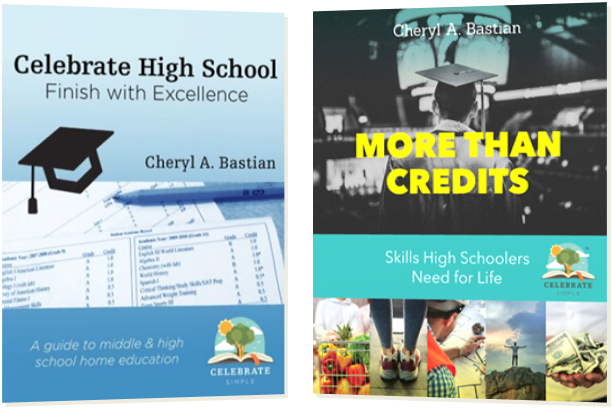
You can Celebrate High School and it can encompass More than Credits!

covers.png

I do not receive any compensation for inclusions on this list. It is completely random--I add to the list as I research and work with families. This list is not intended as endorsement or advertisement; simply as a helpful tool to aid and encourage. 

This list grows and grows. Check back for new additions. 

College Admission Requirements.png

The BIG Comparison: Planning Courses for Admission and Beyond

BIG.png

Yesterday found my high schooler and I at the computer—for two hours!

It’s mid-sophomore year and she knows what she wants to study. With that in mind, she’s building what I call her BIG Comparison List (more details included in Chapter 6 of Celebrate High School: Finish with Excellence). This comparison allows the parent and student to plan a high school path—courses and content—with the student, admission requirements, testing, and major in mind.

Colleges and universities often offer an admissions page specifically for homeschooled applicants.
— Cheryl Bastian, Celebrate HIgh School

Research high school courses required for admission. Home educated students intending to go to college—and even those who are remotely considering it—benefit from researching and anticipating admission requirements of their top college choices. This is helpful no matter what type of entity the student plans to attend: public, private, academy, non-competitive, or highly selective. I keep a running list of links to admission pages for home educated graduates here.

While sitting together, my daughter and I visited the home education admission page for each school on her Big Comparison List (so far). What we discovered was interesting!

What will be required of her for admission to her choices thus far isn’t anything like our other four graduates.

High school is not one-size-fits-all.

Based on what we learned, our current high schooler’s path is looking quite different than her siblings!

Research tests and scores required for admission. Aside from the transcript, test scores can be the most unnerving requirement for college admission. Parents (and sometimes high schoolers) voice this concern when I meet with them. As a parent of past, current, and upcoming high schoolers, I understand!

While my daughter and I were poking around on the admission requirement pages, we found the SAT/ACT test scores expected for applicants. We were also curious about PERT and CLEP scores for one of her college choices. We noted and compared the scores, college to college. Unlike our other graduates, we see a real advantage of both PERT and CLEP for this high schooler.

Check college General Education courses required for the degree. Having studied General Education requirements for many degrees and many universities, there are some common denominators in what is required across degrees. Freshman Composition and Speech Communication are fairly standard for most schools and degrees. There are exceptions, of course. Aside from composition and speech, required General Education courses vary per school and per degree. For example, AS degrees are considered terminal. The goal is to get the student needed knowledge to enter a specific workforce. I order to take the needed career-specific courses, the number of required General Education credits is reduced. Not all colleges and degrees require the same courses or number of General Education credits for graduation. This is why research is important.

Check college course requirements for the college major. Just as the courses and credits vary for the General Education requirements, so do the major requirements. In other words, the major course requirements for a BA in Anthropology at one university will likely vary from the courses required for the same degree at another college. Again, this is why research is essential.

Comparing the General Education courses for my daughter’s intended major at her top college choices (at this time), we discovered none of the colleges require College Algebra (as was the case with all my other graduates for their degrees). In fact, every college my daughter has on her list stated MGF1106 as the General Education math required. Upon further investigation, we discovered CLEP offers a College Mathematics exam. BINGO! She could study for and take CLEP College Mathematics and if she scores high enough, use that test score to earn the General Education math credit she will need. It was also encouraging to know every school she is considering accepts CLEP (this is not always the case—another reason to research).

For us, for right now, what we discovered is a WIN-WIN, worth every bit of the two hours it took to research.

What WIN-WINs are awaiting your high school learners?

Chores in the High School Years

chores.png

This year marks another shift in household responsibilities as our fourth child finished high school, our fifth child continues to move through those years, and two young adult graduates reside at home while working and attending college. All of us are trying to figure out the new normal with new courses and work schedules.

Needless to say, this isn’t our first go-round with adjusting to the schedules of our young adult children while also reconfiguring the completion of necessary daily tasks. (In other words, our experience doesn’t always equate to “we got this”).

When our first child entered high school in the early 2000’s we were broadsided with the thought that we might have to adjust his household responsibilities to make allowance for his new, fuller schedule. Most of the families we knew or books we read added to the confusion with their “they still live there, they still contribute” or “if they are not paying rent, they should be helping” advice.

Honestly, I had to unpack these well-meaning sentiments, the application of which seemed to strain and fray our relationship.

I was pretty sure there had to be a better way, a way we could work together to process and find solutions.

Relationships matter to us.

As our oldest entered high school, his days were full based on the choices he made to weave academics, sports, and service. In the later high school years, he took on a part-time job. Managing his time wasn’t an issue. He was navigating that well, but still had a hard time carving out ten minutes here and there to unload the dishwasher or take out the trash. He was, however, trying to work on it. His heart wanted to serve, but his days were full.

The second high schooler mirrored his brother—academics, sports, and service. He also managed to spend time earning badges on the road to Eagle and mentor younger scouts. Later in high school he, too, had a part-time job. Again, there were only so many hours in the day and his heart reflected an attitude of trying to help where he could. His days were full.

Enter young adults (now graduates) three and four. Different scenarios, different circumstances, same well-intentioned hearts. Again, we are finding the process worthy of mutual care and respect as we find a balance between school, work, and life. It’s a life skill, not something to be demanded or placed upon. And, we get to walk alongside.

But there’s the advice and pressure from other parents. So hard!

I wondered if there were other families facing similar ponderings.

I wondered if our processing would help others in their walk through. On my journey, I came face-to-face with these thoughts:

  • Our high schoolers only has so much time in the day (a real truth for all of us). If I were in any of their shoes (and I have been), I would want someone to coach and process with me, not continue to place demands.

  • Our high schoolers were using time wisely (to the best of their current ability), weaving work and school responsibilities. Again, having been through similar scenarios in life, I remembered I LOVED when people offered grace and an extra hug when I made a mistake and had to try again.

  • When I find myself in a new life season (birth of a baby, health concerns, family needs) it takes me time to adjust. Why would it not be the same for my teens and young adults?

  • Our high schoolers are willing to serve when they are able and obviously high school academics, sports, and service require more time than years prior. How can I be understanding instead of adding pressure?

  • Our high schoolers are in the process of navigating a real-life scenarios - balancing work, school, and life (an important skill which doesn’t happen overnight). I have the ability to believe my high schoolers will figure this out. They need me to be a cheerleader (with my affirming words) of their efforts.

chores2.png

In the meantime, I discovered

I may have to do a few extra dishes or collect a few extra trash cans. My pondering brought understanding and empathy, potential ways for me to walk alongside as teens and young adults process their shifts in responsibility and life seasons.

My support is more meaningful and helpful than my nagging. My teens and young adults are not any different than I. We face some of the same life challenges and temptations. When I face a snag in life, I’m grateful for understanding, connection and communication verses anger, discouragement, and silence. Alibet, I do appreciate if I am doing something wrong or hurtful (sinful) that someone close to me would help me see the blind spot (another life lesson).

I am still learning (even as I adjust to our fourth graduate’s and our fifth high schooler’s new schedules). I don’t always navigate this process gracefully (though it is my heart to do so) but I am getting better at it. Truthfully, It’s hard to set aside the well-meaning sentiments of “he owes it to us” or the “you don’t have time to add this back on your plate or figure out how to adjust to his new stage of life” mentalities that I hear.

Fifteen years into the process of walking new life seasons with young adult children, I am still pondering, pondering deeper thoughts, thoughts that are important to family life, thoughts I now understand better. They matter! Every. Moment. Matters.

Chores.png


Planning 9th Grade with YOUR Freshman in Mind

ninth.png

Four home graduates. One current high schooler.

Five unique ninth grade years.

As I finished adding the grades for the ninth-grade year of the transcript for our fifth high schooler, the proverbial light bulb illuminated my thinking.

I double-checked, looked over each transcript of our five learners.

Indeed, EACH of our high schoolers had a unique and individualized ninth grade year—distinctive of their gifts and strengths. I knew each of our children were different, yet I hadn’t set out their transcripts side-by-side to compare the courses they had completed in the freshman year. Yes, some had earned credit in the same course, but even the content of those courses varied according to the bents and interests of the learner. Same title, different content. Each learner had individualized educational paths, courses tweaked by interests and strengths, goals and aspirations.

As it should be with homeschooling.

Every learner—gifted—different.

None better than the other.

What were the ninth grade courses on our five high schooler’s transcripts?

9th1.png

One of our learners dug into a variety of interests, from academics to sports to music. This learner also extroverted high schooler wanted to take Spanish earlier in the high school plan so that it could be completed with an older sibling. Further observation lead me to realize this learner was the only one who completed two years of foreign language by the end of ninth grade—making time for other studies; a big WIN as far as she was concerned. These ninth grade course choices were right for this learner and provided distinctive advantages in regards to having time for opportunities which were still to come in the later high school years.

9th3.png

One of our other learners enrolled in high school level courses prior to ninth grade, hence completing Algebra 1 and moving to Algebra 2 in ninth. The same was true for science which paved the way for chemistry to be the logical next step for the freshman year. No other learner took Algebra 2 or chemistry in the freshman year.

This learner was also the only one who completed world history in ninth grade due in most part from having studied history independently—and passionately with much depth—in previous years. We didn’t want freshman year to be a repeat of past content so we allowed this student to continue to study history through travel, historical documents, biographies and other non-fiction resources. This high schooler was also the only sibling who completed economics in the freshman year—again due to personal interest and independent study. This course provided additional fuel business-minded young adult.

9th4.png

This learner was a mover, a kinesthetic.Learning was experiential and hands-on, even through high school. Athletics played a major role in this learner’s life, hence all the PE credits in the freshman year (as well as years to follow). For this learner we chose to split American history into two years—Early American (up to the Civil War) and Modern American (after Civil War) allowing time to add experiential learning to a text and provide extended time to other subjects of interest.

9th2.png

This introverted learner loved people—understanding how they thought and were motivated—and was eager to have people live their best lives—hence the bent toward sign language. Interestingly, this young adult’s ninth grade year was also the year our sweet great-grandmother was very ill and in and out of facilities (which the learner requested to tour and research because of the love for Grammy). This learner asked to be a part of the process and dialogued (summarization, recall, and interpersonal communication) with me (and her grandmother) about what was being learned through this heartbreaking journey. This high schooler was also an entrepreneur and a creative—owned a small business—hence the business and creative arts electives. Different learner. Different interests. Different courses.

9th5.png

Another introverted creative, this learner set up a work studio where endless handmade cards were made with numerous types of media and by various techniques. Hours were spent learning technique, researching skills, and experimenting creatively. Hence, this high schooler earned credit in courses not considered by our others—Foundations in Interior Design, Stamp and Stationary Art Design, and Survey of American Musicals. This learner, like several siblings, earned credit for personal fitness, yet her content was very different from the content of athletes who spent hours on the field or in the weight room. This high schooler chose her own relaxing, peaceful blend of aerobics, stretching, and strengthening—using personally-selected workout videos.

Five freshman years each with unique content and character—personalized to the interests of the learner earning the credit.

Personalization doesn’t have to end in ninth grade! In fact, it can continue throughout the high school years in order to help our young adults learn who they are, what they were created for, and how they can bring value to the community in their spheres of influence—at home, across the nation, and throughout the world.

Need guidance in the journey to make high school matter beyond the turning of the tassel?

My NEW BOOK, More than Credits: Life Skills High Schoolers Need for Life, offers frameworks (think practical skill acquisition from real-life, project-based learning, experiential opportunities, related literature and writing assignments, and meaningful decision topics and questions) for FIVE elective courses:

  • Nutrition and Wellness

  • Personal Fitness

  • Personal Awareness and Career Exploration

  • Philosophy, and

  • Personal Finance

The contents of each class are not just boxes to check, but ideas meant to be tweaked and adjusted for each learner based on what they may already be doing.

Earn credit for what matters…not just today, but beyond.


Experiential Learning in High School : The Motivation

Motivation Matters

When a young adult is involved in contributing to content—a vested determination to learn—greater retention and true understanding follow.

Young adults thrive when there’s purpose. If something matters to them, they become invested and personally motivated. When parents give their children freedom where responsibility is evident, growth potential flourishes. The more young people become responsible, the more confidence they gain. It’s a perpetual cycle, much like the ebb and flow adults face.

Our sons were passionate about baseball. Both were pitchers, one a righty and the other a lefty. Improvement in skill and arm strength required discipline, daily workouts, and throwing. What fueled their passion? Motivation to be the best pitcher he could be as well as knowledge of what was needed to meet the goal. It wasn’t me. I hadn’t any idea how to build arm strength or design a workout. Instead, the boys listened to coaches, consulted with trainers, and implemented or tweaked their plans. I encouraged them, served as their cheerleader, drove them to practice, and figured out how to incorporate and communicate all they were doing into credits. Many of the activities they integrated into their days are listed in this resource.

MTC2.png

The content suggestions listed in these five personal development electives aren’t meant to be objectives to be checked off, tested, and graded. They are chunks of knowledge which can be gleaned from life, fully understood in the context of life experiences. Will resources—print, digital and personal contacts—be needed? Likely, yes! And, the lists I provide aren’t meant to be exhaustive. They can’t possibly be because each high schooler—and their circumstances—is unique. Their courses will be as well.

Many of the ideas or projects listed in this book stem from real-life scenarios or situations our children—or the hundreds of high schoolers we’ve worked with—faced or were curious about. You will notice much of the content will be learned from naturally-occurring conversations, often because of a young adult’s interest, personal need, or life circumstances. These discussions were often catalysts for deeper study, additional conversations, or visits to the library…and our high schoolers earned credit!

Later in the chapter….

For learners who have an inkling of what their post-high-school paths will be, they will move forward in that direction. Along the way, they will need help to process and question. They will seek out people who are willing to listen. Likely that person may be you! Embrace it. The conversations may feel constant and never-ending. However, the reality is that the time will be very short. As you help process your high schooler’s ideas, keep an open perspective. Be ready for change. An interest one semester may transform into a niche the following semester. It really can be a beautiful personalized journey.

Let’s say your high school learner is interested in pursuing a career in veterinary medicine. Talking with her, you believe the next right step would be to talk with professionals in the field. As move through the brainstorming process, you and your daughter make a list of venues which could be possibilities for volunteering or job-shadowing experiences: a vet's office, a local clinic, and the county animal shelter. As you discuss how to prepare for possible conversations with professionals, you list questions which could be asked in an interview situation. They may include

  • What universities are considered optimal for preparation of a career in this profession?

  • What are the potential degree and career paths available?

  • What classes or experiences were most helpful to you in the education process? 

  • What are the specialty areas in this profession?

  • What areas, in any, do you recommend or foresee might be most helpful five years from now?

  • What would you, as a professional, recommend for a young adult pursuing this career?

(Excerpted from More than Credits: Skills High Schoolers Need for Life)

Perhaps your high schooler is motivated to learn more. You may not feel you have the expertise or the knowledge necessary to help your young adult move forward. Guess what? You are not alone. And, you don’t need to know the answers. There are people in your high schooler’s field of interest who do, people who work in the profession. Seek them out.

Wondering what types of questions you and your learner could brainstorm together? I offer ideas in this post. This is a sampling in what you will find in More than Credits: Skills High Schoolers Need for Life.

High school is more than credits. It’s being future-ready.

Preparing High School Learners to Interview Professionals

MTC3.png

We can’t know everything.

No one can. But, we do have the ability to know how and where to get our questions answered. Our learners should be empowered to do the same.

Let’s say your high schooler is interested in veterinary medicine. Your majored in business and finance.

How do you help your young adult learn more about this career field?

Find a trusted professional who is willing to share his or her passion, and then ask. Most people wait eagerly for an opportunity to talk about what they love. In the process, your young adult is afforded a chance to learn about the education requirements, niche areas of the profession, and perhaps even what the career might look like in the future (at the time when you learner is trying to land a job) from a person in the know. In addition, should an ongoing mentoring relationship form, there may be a potential connection made for later employment.

Identifying a person who could be interviewed is the first step. The second step, preparation, is key. Intentionality often reaps the greatest reward (another one of those life lessons our high schoolers learn from experiential learning).

Preparing for interviewing is an important skill. Afterall, if someone carves out time in a schedule to meet with a high schooler, being prepared for the meeting not only allows the learner to glean the most helpful information possible, but also shows respect for the professional’s time. Some high schoolers decide they need help brainstorming to make a list of questions and practice asking those questions through a role play scenario. Other young adults prefer to work more independently to create their list and then seek input or additions from someone they know will provide feedback. This process is another step in discovering how one learns best is a unique benefit of experiential opportunities.

When our high schoolers showed interest in an area and wanted to talk to professionals in the field, we developed a list of questions. I offer a full list in the appendices of More than Credits, but these examples will jump start the thinking process for your high school learner.

  • How did your high school experiences benefit your career?

  • Where did you attend college?

  • How or why did you decide to choose this college?

  • How did your post-secondary studies influence your career?

  • Which post-secondary courses were particularly beneficial in your career preparation?

  • Is there something you feel would have been helpful—maybe even a different major—than what you pursued?

  • How do you see your career field changing in the next five years?

When preparing to interview someone in a trade or technical field, we adjusted our list of questions to address trade-specific aspects of a field. The complete list is also included in the book, but again, these should provide a place to start as you and your learner develop a list of questions.

  • Did you earn industry certifications and if so, which were helpful to you?

  • What should I consider as I research post-secondary education options?

  • What skills do you use every day?

  • What types of writing do you do in your field?

The high school journey is more than taking tests and finishing study guides. Those do have a place in education, but it is important to remember these aspects of learning should not overshadow and crowd out some of the most beneficial ways our young adults gain knowledge—through experiential learning opportunities like interviewing professionals.

Available through Amazon.

Experiential Learning in High School: Why It Matters

Copy of High School Photography Elective - Pinterest .png

I find it ironic that homeschooling parents encourage young children and elementary-age learners to explore their interests, yet as the middle and high school years loom on the horizon, the tune often changes.

When it does, students, parents, and educators tend to concentrate on core courses (with good reason) while pushing strengths and giftings—and often real-life learning—aside. Often those life experiences offer learners the lessons and skills most needed for their future.

There is another advantage of pursuing electives of interest. Not only do high schoolers receive credit, but these pursuits also help reduce the stress of typically tougher core courses.

By their very nature, electives provide avenues for personal growth, renewal, and skill acquisition.

Wouldn't it be wonderful if the middle and high school years provided the same real-life educational opportunities found in the younger learning years? Homeschooling makes that possibility a reality.

Interest leads to higher-quality content and greater retention in both core and elective classes. With this knowledge in one hand, grab a cup of coffee or a thick creamy milkshake with the other and invite your high schooler to brainstorm with you. In the course of the conversation, listen to what he or she would like to study and how those interests could be enhanced or accomplished with real-life experiences. Experiential learning in high school is just as valuable as it was in the elementary and middle school years.

Copy of High School Photography Elective - Pinterest  (1).png

More than Credits: High School Philosophy, Morals, and Ethics

philosophy.png

The high school years offer a season to celebrate the people our young adults are becoming. Part of that transformation is coming to understand how thoughts influence words and behavior as well as how to productively evaluate thoughts and the thought process.

Along that journey, there will be moments of confidence, clarity, and productivity, but there will also be times of disagreement,miscommunication, and debate. Our high schoolers are learning how to think and then communicate those thoughts while expanding their problem solving abilities and processing their mistakes, all in the light of what they believe to be true.


In this season, young people continue to learn details about who they are and what value they bring to their spheres of influence.


It’s philosophy; discovering a clearer picture of what one believes when compared to other’s thoughts and how those beliefs affect actions and words. It’s the wrestling with and expressing of morals, values, and ethics. It matters, and it can count for high school credit.

As you embark on the adventure, one of the first questions you may encounter is what content to include in a philosophy-type course. You aren’t the only one asking this question. In fact, many parents face this question, and usually haven’t had any idea where to start.

I’ve been in that place, too.

In fact, it’s why I decided to offer suggestions and a framework for a philosophy-based course in More than Credits! The content will empower and encourage you, offering selections for

  • high-interest reading materials,

  • suggestions for writing assignments, and

  • practical hands-on experiences which will impact the young adult as well as the lives of others.

graphicstock-unrecognizable-grandmother-and-her-granddaughter-holding-hands_rRgFwoP6ZZ.jpg

Intentional.Real. Relational.

More than Credits: Skills High Schoolers Need for Life

Ethics, the moral principles which undergird the standards by which individuals respond to important life questions, develop as we face life circumstances and choices. In those moments, we decide what we believe, why it matters, and where we will place our time and attention. Our high schoolers are no different. They face daily decisions amid a myriad of worldviews and philosophies.


What they believe about God, themselves, and the situations in the world, matters. Home can provide a safe place to investigate truths, dialogue thoughts, and ponder choices.


A course which involves the development of philosophy, morals, and ethics gives high school learners opportunities to earn credit for wrestling with their thoughts, discovering what their faith means to them, and applying those thoughts to their life choices and their relationship with God.
— Cheryl Bastian, More than Credits: Skills High Schoolers Need for Life

Most importantly, a young adult’s moral and ethical thoughts influence the decisions they make. Essentially, the content cultivates the “why” behind what an individual believes as well as why certain things are valued over certain other things. All of this encompasses an individual’s belief system and influences his or her spiritual growth and personal development beyond simply mimicking, borrowing, or living out the faith of his or her parents.

One of our learners grew to love C. S. Lewis. He had read the Narnia series earlier in his homeschooling years, but as a high schooler selected A Year with C. S. Lewis: Daily Readings from His Classic Works (HarperCollins Publishers, 2003) from our home library shelves. I had no idea he had such an appreciation for the author. I marveled how the devotional motivated him to read a handful of other classic Lewis writings. Amazingly, content developed because of his newly discovered curiosity for C. S. Lewis’s thoughts and the course began to take form without any planning on my part. I simply (albeit battling fear he would learn enough!) fostered his vested interest. Realizing the impact of self-selected reading, not just philosophical material but other resources as well, we adopted a motto in our home:

“Read the book and I will award credit for your accomplishment.”

Ultimately, one book led to an independent study, which we combined with other activities and great conversations! Seeing our son’s continued interest Lewis and then other great thinkers, Mike and I decided to read the books he was reading. Mike asked if he wanted to spend time each week talking about what we were learning, all of us. Without much direction about where our discussions might lead, we began to meet, ponder, and converse. Hearing each person express his or her opinions or interpretations about what was read and how those thoughts could be applied to current circumstances provided a venue to process viewpoints—the Socratic method, family-style.

IMG_5628-705.jpg

We couldn’t possibly comprehend the fullness or richness of our first steps. Our dialogue through one book fueled more reading and before we knew it a weekly forum took shape. Best of all, something greater resulted: our relationships with one another deepened. We gained respect for one another and realized we could learn together. We weren’t just teaching our son. He taught us!

A few years into meeting consistently, our son commented, “I wish everyone had the opportunity to be in a community like this.” Years later, when we talked about the depth of our conversations, he commented, “Those years are the main reasons why I lead a small group at church today, so others can have the same opportunity I did!”

Wow! That’s philosophy credit with future implications.

Philosophy courses continue to fade from high school curriculum guides. Thankfully, our homeschooling freedoms allow for this essential course to remain a feasible choice for young adults. In fact, conversational group setting provides one of the most beneficial venues to process and ponder the philosophical thought which undergird and permeate life. Consider gathering your family or your young adult and his or her friends to ponder life together.

Conversations, heart connections with our young adults, provided some of the most meaningful experiences of our family’s high school years. Some of the most treasured, thought-provoking discussions happened over half-price milkshakes pondering a life-truth or a plate of nachos after losing a baseball game.

When we paused our days, looked one another in the eyes, and listened, family members knew their ideas and thoughts mattered.

And, philosophical, moral, and ethical thoughts and beliefs formed all the while.

COVER_More Than Credits_Book_byCherylBastian.jpg