

Transcript Matters: More than One Transcript?
/
A common question…
“My high schooler received some credits at the local public school, some through an online venue, and still others through dual enrollment. Do I need to create more than one transcript?"
Great question. Home educated students benefit from a variety of possible learning environments. Some of these entities are transcript-generating, meaning the entity is accredited and provides educational oversight for students who take classes through their venue. Others do not produce transcripts (some co-ops and support group opportunities, private instruction and tutoring, church courses and seminars).
First, it may be helpful to understand what a transcript is.
A transcript is a permanent academic record which includes all grades conferred to the named student. It represents the student's academic record; a visual summary of the student's high school years.
As the homeschooling parent overseeing your young adult's learning, you know your learner's academic record in its entirety, both in the home and away from the home. You know when courses were taken as well as which entity provided oversight for each class, whether it was an accredited transcript producing entity or not. You know whether some credits were earned at the local public school, and whether the course included CLEP or AP content, if the corresponding tests were taken, as well as what scores the student achieved.
Yes, entities may have conferred grades and credits, but you know where and when those grades and credits were earned. The parent-generated transcript you provide not only validates the courses, grades, and credits received directly under your supervision, but also offers employers and universities an overview of course variety and environments from which the student benefited, in and out of the home. Therefore, every course, grade, and credit is documented in one place--on the parent-generated transcript. It is the master transcript and the parent-generated transcript alerts any employer or university that transcripts will be provided by other entities.
With six home education grads who entered colleges and universities, we experienced this first hand transcript requirements. In every case, having all courses--no matter where they were taken--documented on the parent-generated transcript was required in the admission process.
How do we note courses taken outside the home?
First, a distinction must be made. We asked
"Was this course taken under the oversight of a legally-recognized, transcript-generating entity?"
If the course was taken at such an entity, we flagged the course on the transcript, meaning we added some type of notation super-scripted above the grade. An explanations of the flags was added under the grading scale of our transcript.
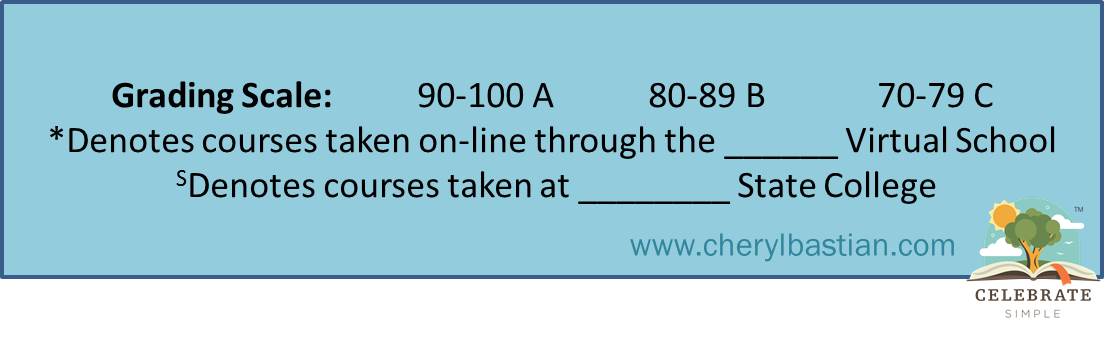
For example, all of our high school learners completed foreign language online through an accredited source. I didn't create the course, its content, or grade the work. This was all provided by the online instructor. As the parent overseeing the education of my student (outlined in our state statute), I knew the course was taken and that the source was accredited by the state, and was a transcript-generating entity. I added the course to my parent-generated transcript to provide universities with the information that the foreign language requirement was met. My superscript alerted the schools that they would be receiving an additional transcript for admission purposes.

For some students, there may be several superscripts. I worked on a transcript recently for a student who had taken courses at the local public high school, a private school, an online public school, and a state college. The superscript above the corresponding grades provided admission personnel with a quick, concise visual of where the student had received her high school requirements.
The parent-generated transcript not only validates the courses, grades, and credits received directly under the parent's supervision, but also offers employers and universities an overview of course variety and environments from which the student benefited, in and out of the home.
This blog post is intended to offer an example of personal experience. It is in no way intended to be legal advice and should not be taken as such. Parents own the sole responsibility for the training and education of their children.