Delighted to Be a Speaker at FPEA 2016

I am thrilled to be back at FPEA again this year. New workshops. New insight. New stories and practical helps to equip and encourage at every stage of the home education journey, preschool through high school.

Come see me at my workshops! I'm walking the journey with YOU!

Friday 10:30am

7. Celebrate Simple! Intentional Home Education

The simple teaches the profound. Cheryl shares stories and offers insight from her 21 years of homeschooling eight children — the everyday teachable moments, the simple yet ingenious ideas, the interest-driven learning — the things her graduated and grown young adults say mattered most. Learning together, building family relationships, is priceless. It's simple and worthy of celebration!

Friday 3:55pm

68. Happy (High School Paper) Trails to You!

High school is not a one-size-fits-all experience. It is a time to refine the skills needed to polish a student's God-given gifts and talents. But what does that look like on paper? How do you tailor courses which will prepare your child for what God has planned for their future? Cheryl walks parents through answers to these questions.

Saturday 1:45pm

129. Celebrate Middle School: Fostering Ingenuity

Middle schoolers will surprise you! When they do, be ready to foster ingenuity, seize opportunities and think outside the box. The middle school years, ripe with potential to impact entrepreneurial ventures, employment or college/career paths, can also be conflicting for parents and children. In this workshop, Cheryl offers practical tips from experiences as a homeschool mom and a wife of a 27-year middle school educator.

Saturday 3:55pm

153. Teaching Precious Preschoolers and Little Learners

Young children have an insatiable curiosity to learn and a natural desire to work alongside people they love most. How do we utilize these innate qualities to maximize their learning potential at home? Drawing from 28 years of experience of teaching early learners, Cheryl challenges attendees to look beyond societal and educational pressures to the emotional and developmental needs of young children. 

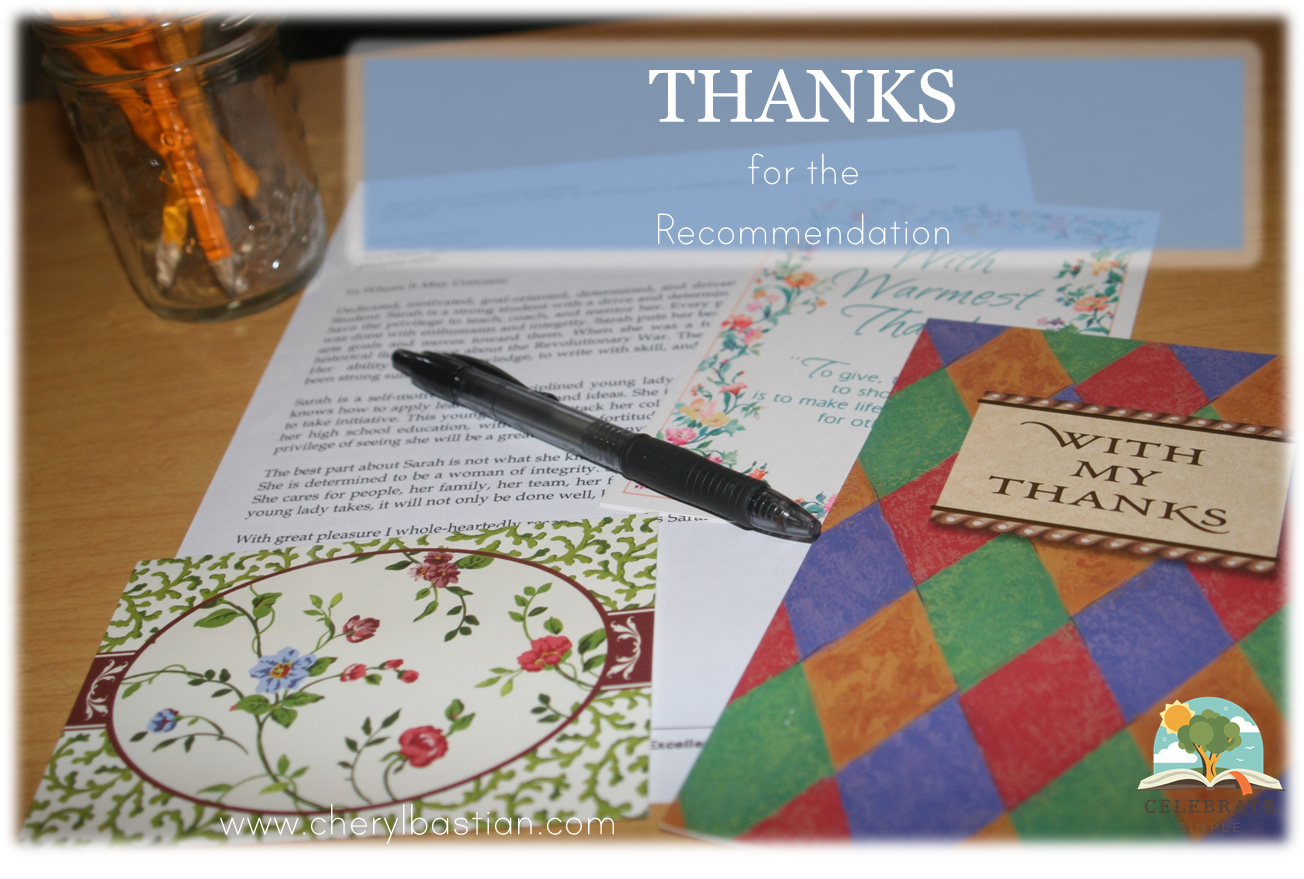
The Thank You After the Letter (of Recommendation)

Letters of recommendation act as a means of introduction to a person’s work ethic, character, unique abilities, and personal or academic strengths. These letters accompany applications for employment, college admission, and scholarship monies. In some cases, these letters are highly regarded. Instructions and insights to these important documents, including sample letters, are included in my book Celebrate High School.

What happens after a letter of recommendation is written and submitted? What constitutes an appropriate thank you for someone who has taken personal time to speak on behalf of an applicant?

I have been on both sides of the letter.

As a mom walking alongside young adults who have sought internships, employment, leadership positions, college admission, and scholarships it was important for me to know and understand the letter of recommendation process—from inquiry to thank you. Gaining that knowledge, I could more effectively coach and encourage my young adults.

Having walked this path several times with my young adults, I found each experience unique and in large part, dependent on the young adult’s relationship with the recommender. Considering many aspects we were able to tailor the communication, inquiry, and thank you to each situation. Therefore, our plans of action did not follow any protocol, only our discernment and determination of what we felt was appropriate for each individual.

When our son sought a letter of character recommendation from a person with whom our family had interacted for several years—which included an influential relationship with our son—we decided a gift card to a favorite restaurant should accompany our son’s hand-written letter. There were years of conversations and meetings put forth on behalf of our young adult.

When our son sought a letter of academic recommendation from an online instructor (as required by the university) with whom he had only a semester worth of interaction—though she had commented often on our son’s ability and her confidence in his character—he thanked her with a sincere email. With only an email for communication, he was limited in his choices to show appreciation.

As a person who helps young adults achieve their goals, I am often asked to write letters of recommendation and scholarship. I am honored to fill this role in a young person’s life, and honestly, the best compensation has been a note of thanks and a follow up as to outcome of the opportunity.

Walking alongside a young adult, you may be asked for ideas in regards to showing appreciation toward a person who writes a recommendation.

Consider:

  • First and foremost, express gratitude. Though letter writers are often honored to speak on a student’s behalf, gratefulness is always esteemed. Express thankfulness for the writer’s thoughtful comments as well as the time set aside to give attention to the letter. In addition, this person, having impacted the young adult may be of help in the future. In fact, most of the people who have written letters of recommendation for my children have indeed maintained friendships with us, some providing future employment leads and networking scenarios later.

  • Giving the means of appreciation but  later provide follow up correspondence as to the outcome or impact the letter had on achieving the intended goal. As a writer of recommendation letters, I always wonder whether my efforts were successful; helpful to the young adult’s objective.

  • Adding an explanation of why person is important or has been essential to the young adult’s development or education; a great complement to a handwritten thank you.

  • High school guidance counselors and teachers as well as university professors generally agree that writing recommendations as part of their job as an education professional. Though this shouldn’t determine the means of appreciation, it does deserve consideration.

  • Whether or not a thank you note is the preferred means of gratitude, an in-person delivery or face-to-face word of thanks is often highly regarded and appreciated.

  • Some professionals will not accept gifts, monetary or otherwise. If your young adult presents a gift to the writer and it is returned, be ready to discuss why the young adult shouldn’t be offended by the decline.

What a thrill to watch a young adult of great character, work ethic, and ability obtain something he or she had worked so hard to achieve: winning substantial scholarship, obtaining university admission, being appointed to a military academy. I hope this post has equipped you so that you can experience the same delight.


This blog post is intended to offer an example of personal experience. It is in no way intended to be legal advice and should not be taken as such. Parents own the sole responsibility for the training and education of their children. 

College Admission Requirements for Home Educated Students

I speak to rooms full of parents--everything from living rooms to convention halls--considering a home education journey for their middle and high school young adults. Most often we talk about specifics and how-tos. However, at some point, usually during a Q&A session, I am usually asked

"What about college admission?"

The answer to the question depends on the status of the student applying.

Home educated in our state means enrolled in the Home Education Program with the county of residence. Those students are home educated students by definition and will apply to colleges as home educated, non-traditional or non-accredited graduates. The term used varies college to college.

In our state if the student chooses to enroll in a private school for classes once, twice, or three or more times a week--or as a place of record--that student is considered a private school student and will apply to colleges as a private school graduate. Some colleges and universities require private schools to be accredited, by the state or by a regional accrediting agency. 

Generally colleges welcome home educated students with unique educational and extra-curricular experiences and varied community service opportunities, but it is always wise to check on the admission requirements of particular schools of interest. I recommend parents and students begin THE BIG COMPARISON--outlined in my book Celebrate High School--when several colleges have sparked a desire for further research. 

Don't assume.

  • Universities are hiring counselors designated to serve home educated students. After reading online admission requirements, make contact with the counselor. Advanced research demonstrates interest and initiative.

  • A running list of questions may be helpful.

  • Early research allows parents and students to plan well. Gain the knowledge you need!

Locating the specific requirements for home educated applicants takes time. If your student's college of interest is not listed below, try 

  • typing "homeschool" or "home education" in the search box of the college website.

  • searching "homeschool coordinator" in the search box of the college website.

  • contacting the homeschool admissions coordinator. Colleges and universities are hiring personnel to help their home-educated applicants.

  • looking for homeschool admission requirements under the heading "non-traditional". Home education is considered a non-traditional method of education by many universities.

Direct links to information relevant to home-educated applicants:

Agnus Scott College, Decatur, GA

Amherst College, Amherst, MA

Appalachian State, Boone, NC

Arizona State University, Phoenix Area, AZ

Ave Maria University, Ave Maria, FL

Barnard College - Columbia University, New York, NY

Berry College, Mount Berry, GA

Bellhaven University, Jackson, MS

Belmont Abbey College, Belmont, NC

Bentley University, Waltham, MA

Bowdoin College, Brunswick, ME

Bradley University, Peoria, IL

Brandeis University, Waltham, MA

Brown University, Providence, RI

Bryan College, Dayton, TN

Bucknell University, Lewisburg, PA

California Institute of Technology, Pasadena, CA

Cedarville University, Cedarville, OH

Central Methodist, Fayette, MO

Charleston Southern University, Charleston, SC

Colorado Christian University, Lakewood, CA

Colorado State University, Fort Collins, CO

Columbia University, New  York

Covenant College, Lookout Mountain, GA

Drexel University, Philadelphia, PA

Emmanuel College, Franklin Springs, GA

Emory, Atlanta, GA

Emory-Riddle Aeronautical University, Daytona Beach, FL

Flager College, St. Augustine, FL

Florida Gulf Coast University, Ft. Myers, FL

Florida Institute of Technology, Melbourne, FL

Florida State University, Tallahassee, FL

Franciscan University, Steubenville, OH

Furman University, Greenville, SC

George Mason University, Fairfax, VA

Greensboro College, Greensboro, NC

Grove City College, Grove City, PA

Guilford College, Greensboro, NC

Hillsdale College, Hillsdale, MI

Houghton College, Houghton, NY

Indiana University, Bloomington, IN

James Madison University, Harrisonburg, VA

John Hopkins University, Baltimore, MD

Kansas State University, Manhattan, KS

LeTourneau University, Longview, TX

        Home School Endowed Scholarship - Le Tourneau

Liberty University, Lynchburg, VA

Marquette University, Milwaukee, WI

Massachusetts Institute of Technology, Cambridge, MA

Mercer University, Macon, GA

Messiah College, Grantham, PA

Methodist University, Fayetteville, NC

Montreat College, Montreat, NC

New Mexico Tech, Socorro, NM

North Carolina Wesleyan, Rocky Mount, NC (see page 15 of the college catalog) 

Northeastern University, Portsmith, NH

Oberlin College and Conservatory, Oblerin, OH

Ohio State University, Columbus, OH

Ohio University, Athens, OH

Olgethorpe University, Atlanta, GA

Patrick Henry College, Purcellville, VA

Pensacola Christian College, Pensacola, FL

Pennsylvania State University, University Park, PA

Pepperdine University, Malibu, CA

Princeton University, Princeton, NJ

Reed College, Portland, OR

Rice University, Houston, TX

Rollins College, Winter Park, FL

Savannah College of Art and Design (SCAD), Savannah and Atlanta, GA

*SCAD admission required documents

Smith College, Northampton, MA

SMU- Southern Methodist University, Dallas, TX

Southeastern Louisiana University, Hammond, LA

St. Johns College, Annapolis MD and Santa Fe, NM

Stanford University, Stanford, CA

Stetson University, Deland, FL

Southern Methodist University, Dallas, TX

Syracuse University, Syracuse, NY

Syracuse University School of Architecture, Syracuse, NY 

  • Syracuse University School of Architecture portfolio requirements

Taylor University, Upland, IN

Texas Christian University, Fort Worth, TX

The College of William and Mary, Williamsburg, VA

Tulane University, New Orleans, LA

United States Air Force Academy, Colorado Springs, CO

United States Navel Academy, Annapolis, MD

University of Alabama, Tuscaloosa, AL

University of Central Florida, Orlando, FL

University of Cincinnati, Cincinnati, OH

University of Illinois, Urbana, IL

University of Michigan, Ann Arbor, MI

University of Minnesota, Minneapolis, MN

University of New Hampshire, Durham, NH

University of North Carolina, Chapel Hill, NC

University of North Florida, Jacksonville, FL

University of Notre Dame, Notre Dame, IN

University of Oklahoma, Norman, OK

University of Pennsylvania, Philadelphia, PA

University of RIchmond, Richmond, VA

University of South Florida, Tampa, FL

Valdosta State University, Valdosta, GA

Vanderbilt University, Nashville, TN 

Vassar College, Poughkeepsie, NY

Washington State University, Pullman, WA

Wheaton College, Wheaton, IL

Yale University

I do not receive any compensation for inclusions on this list. It is completely random--I add to the list as I research and work with families. This list is not intended as endorsement or advertisement; simply as a helpful tool to aid and encourage. 

This list grows and grows. Check back for new additions. 

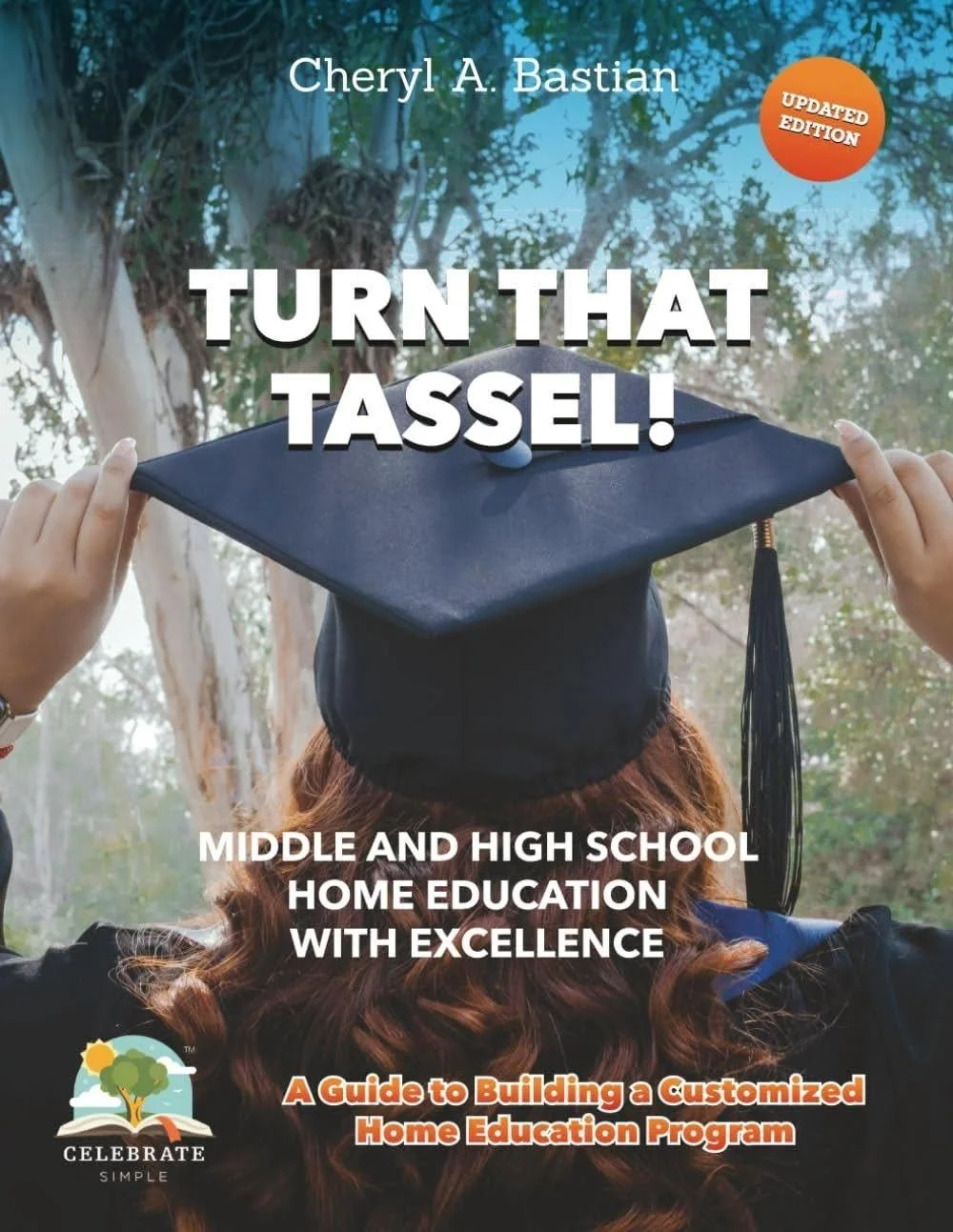
Turn that Tassel! Middle and High School Home Education with Excellence
Sale Price: $38.00 Original Price: $45.00

High school is not a one-size-fits all experience. The journey is unique for every student. Turn that Tassel! equips parents and students of any educational philosophy with easy-to-follow explanations and ready-to-use examples to help families customize their home education programs.   

This blog post is intended to offer an example of personal experience. It is in no way intended to be legal advice and should not be taken as such. Parents own the sole responsibility for the training and education of their children. 

Celebrate High School- What Matters?

"As you walk through the last years of your student's high school journey, remember the final celebration is less about the knowledge stored up in the student's mind (though that is important) and more about whether the young adult understands his or her strengths and how those strengths will bring value to whatever he or she endeavors." 
Celebrate High School, 2015 revised edition
Celebrate High school is available here!  
 

A New Year to Create, Cultivate and Celebrate

How will you be intentional to create, cultivate and celebrate in your home?

Perhaps...

  • Organize an art corner where ingenious minds can create.
  • Refresh art supplies. Introduce a new medium.
  • Bind last year's art masterpieces creating a portfolio to celebrate progress and change. 
  • Offer new tools to cultivate life learning --protractors, microscopes, compasses, templates, 3-hole punches, staplers, balance scales
  • Use New Year savings offered by digital scrapbook companies to create a family memory book where accomplishments and memorable favorites can be celebrated...TOGETHER!
  • Provide blank books to budding authors and illustrators. Cultivate the need to create! 
  • Say "yes" to requests for household trinkets and treasures. They may just be the next patent in the making. 
  • Purchase a personal bookcase to fit bedside the contagious reader. 
  • Read to the emergent reader eager to build fluency. Celebrate the sentence read and the chapter completed!
  • Post a black-out list where newly mastered multiplication facts can be crossed off.
  • Champion ideas and celebrate milestones. 
champion3.png

Making Learning Relevant for Middle and High School

Though summer annual evaluation season ended a few months ago, I continue to post frequently asked questions to help equip and empower parents.

 Knowledge is power in the high school years 

and adds confidence to the journey.


One mom asked:

Recently in our area there seems to be limited diversity in learning environments for middle and high schoolers. Many venues provide only traditional classroom settings or online meetings. This is not the best setting for my child. What other opportunities are available and acceptable?

 This is a tremendous question with valid concerns.

 First, check the home education laws in your state

 Second, having some experience with online learning is beneficial. Online education is growing. And, it did prepare our graduates for post-secondary education.

 Those points being said...

Home educated middle and high schoolers have the opportunity to partake in a variety of learning environments; a definite advantage over their public and private schooled peers.

Our middle and high school students learn widely from a variety of environments. One started a business and learned on the job, everywhere from church fellowship hall craft shows to convention trade show floors. Another learned from independent study, volunteering, and conversation from professionals in the field. Still another learn from contractors, field work, job shadowing, and collaboration with peers. Our home education statute allowed us the freedom to utilize these means. We are all grateful we could fit learning with learning style and student interest.

When designing courses or considering courses for middle or high schoolers the learning environment is essential and often dependent on the learning style and strengths of the individual. For example, if the student learns best by observation, perhaps best fit environments would include laboratory settings, field work, internships, job shadowing, or apprenticeship. In these settings, the student can observe to learn. If the student is an auditory learner the best settings may be research laboratories or classroom instruction.

When the course is complete, if our students were applying for a university requesting course descriptions in addition to a transcript, I made sure to be specific about which environments the student used. Often the environments, being different than a typical classroom or online setting, were intriguing.

Yes, the reward was worth the effort. The contents of the course descriptions, transcripts and cumulative folder were the documents which set a solid foundation for resume writing.

 And in the end, as we--student and parent--looked over documents, the accomplishment was a part of our celebration of high school and the ability to finish with excellence.

 As you consider the potential learning environments your learner may have access to, ponder how those opportunities may benefit your young adult. The results can be astounding.

Magnificent, Make-A-Difference Middle School

cheerleader.png

Celebrating high school begins in middle school. Given opportunities to develop strengths and interests, the middle school years and their subsequent experiences set the stage for future decisions. Decisions move middle schoolers forward, or set them back.

Middle schoolers need coaches, cheerleaders, people to cheer them on, answer their questions, affirm their successes, and come alongside when ideas fail. Like adults, middle (and high schoolers) gravitate toward sources or encouragement and affirmation.

Our experience is that middle and high schoolers will hang out most with those who encourage and affirm them best. 

Mike and I were (and still are with our current middle and high schoolers) intentional to champion their interests. As a result we were (are) invited into their successes and their messes!

Middle schoolers need help understanding themselves. Mike and I have learned that before we can help our middle and high school young adults understand themselves, we must know them! To know them, we must spend time with them (even when it's hard to be with them). Spending time means observing, listening, and asking. We watch how they respond in both stressful and rewarding circumstances. We observe what activities they enjoy and what makes them smile. Body language and verbal responses are windows into their hearts. What they read expresses their interests. Who our children talk about gives us understanding into the character they emulate or respect. Knowing our children takes diligence and purpose, but is deserving of my time and energy.  

When we come to know our children--what motivates, intrigues, and captivates them--we can begin to help them understand themselves. 

Middle schoolers want to make a difference. Middle schoolers need time and experiences to help them understand who the are and what they can contribute to the family, community, nation, and the world.

They need something to ponder, practice, and pursue; a way to make a difference. 

Making a difference they feel the satisfaction of collaborating and contributing, serving and giving.

Middle schoolers need help managing their time.Several facets of life motivate middle and high schoolers to manage their time: knowing they have skills to solve a problems, having a project to complete or understanding their skills can contribute to a cause. When these aspects are discovered and fostered, managing their time matters.

Time management is a necessity for accomplishment.

Middle schoolers encouragement for organization.Middle schoolers are not usually naturally organized. They usually need parents to help them brainstorm ideas. They need someone to take them shopping for organizers.

Organization is often key to time management. 

Middle schoolers need help finding and using resources. Middle schoolers have ideas and interests they want to pursue. There are things they want to build, books they want to write, businesses they want to start, logos they want to design, and fish they want to catch. Resources, tools, and significant people put those ideas and interests in motion. One of the greatest resources is time--time to process, time to think, time to talk through ideas. In and through conversation and experience, middle schoolers learn to plan, design, analyze, and evaluate, all which work together for understanding.

Without time, these key life skills cannot develop. 

Middle and high school young adults are really not any different than adults. 

Adults thrive when they understand their strengths and have the freedom to grow in those strengths, when they have people to help them process ideas and adults, when they have access o necessary tools and resources to carry out the plan, and when they are surrounded by supportive family and friends. 

Middle schoolers will surprise you! Middle school years have great potential to directly impact a student's entrepreneurial ventures, employment, or college and career path by offering options of promising study. Be ready for your middle schoolers to surprise you! Ours have surprised us many times with their ideas and plans. They had solutions we had not discovered, insight we could not see. Theirs were not only better, but because they "owned" the plans, they were more excited and successful in executing the steps to reach their goals.

This content is excerpted from the new expanded edition of Cheryl's book,  Celebrate High School: Finish with Excellence, A Guide for Middle and High School Home Education.